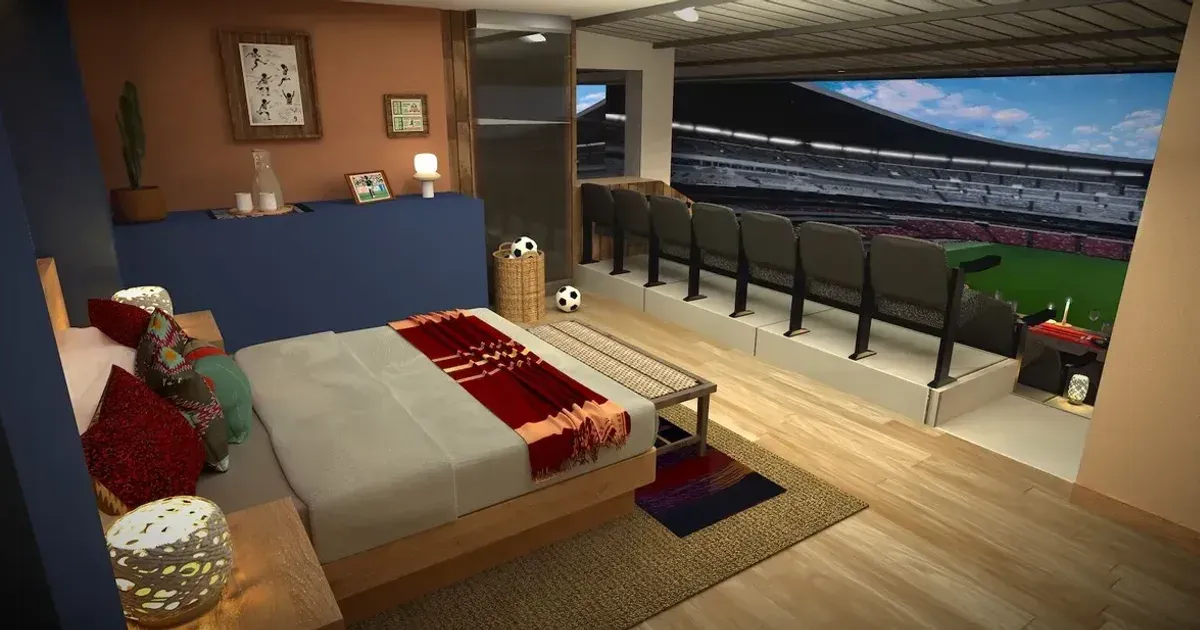
Hugo Sánchez stood on the grass of Estadio Azteca on Tuesday to announce a shift in how luxury tourism intersects with global sport. Airbnb plans to convert pitch-side suites into overnight accommodations for a select group of four guests during the lead-up to the 2026 FIFA World Cup. Participants were set to gain access to the venue on April 5 and 6 in an initiative that pairs high-end hospitality with direct access to the most storied football pitch in North America.
Sánchez, who is still a central figure in Mexican sporting culture, will serve as the primary host for the duration of the experience. Mexico City is a primary hub for the upcoming tournament and this promotion targets the intersection of brand marketing and sports history.
But the offering extends beyond a simple hotel room replacement by including a selected schedule of historical engagement. Guests will inhabit two private suites overlooking the field where Pelé secured his 1970 victory and Diego Maradona executed the Hand of God goal in 1986. These suites have been refitted with premium amenities while maintaining a direct line of sight to the turf. Airbnb described the arrangement as the first instance of an overnight stay inside the stadium walls. Each guest receives a behind-the-scenes tour led by Sánchez to explore the tunnels and locker rooms that have housed generations of legends. This is a major gamble on the value of exclusivity in a crowded travel market.
Hugo Sánchez Hosts First Estadio Azteca Overnight Stay
Sánchez brings a specific pedigree to the promotion as a former Real Madrid striker and the face of Mexican football excellence. He will guide guests through an area dubbed La Tribuna de Hugol where fans can engage in physical activities like bicycle kick drills. The space also features foosball tables and soccer video games designed to create a nostalgic atmosphere for visitors. Meals for the group will be handled by a private chef specializing in traditional Mexican flavors. Participants will also have the opportunity to personalize soccer gear with a local experience host. The schedule is designed to maximize the time spent within the stadium footprint before the venue closes for final tournament preparations.
Mexico City Stadium is the heart of football in Mexico and the stage for some of the most important moments of my career. It is a place that commands respect, inspires and safeguards unforgettable stories.
Still, the most valuable component of the package is the guaranteed access to the opening match of the 2026 FIFA World Cup on June 11. Tickets for this match are among the most sought-after commodities in the global sporting calendar. Mexico is scheduled to face South Africa in Group A for that inaugural game. Securing entry through a commercial partnership allows Airbnb to bypass standard lottery systems that typically govern FIFA ticket distribution. The company is using its platform to bridge the gap between digital booking and physical attendance at high-stakes events. Market analysts note that such partnerships are becoming standard for tech firms seeking to dominate the sports travel sector.
Estadio Azteca Renovations Target Modern Infrastructure
Separately, the stadium itself is undergoing a series of focused upgrades to meet FIFA's stringent 2026 requirements. Work crews are currently prioritizing improvements to entrances, exits, and general spectator facilities to handle the anticipated crowds. Capacity for the tournament is expected to settle at approximately 83,000 following these adjustments. Structural changes have been avoided to preserve the historical integrity of the bowl which was first opened in 1966. The current renovation phase aims to simplify the flow of thousands of fans through the Tlalpan district. These updates are essential for a venue that will make history as the first to host three different World Cup tournaments.
The renovation project balances the demands of modern safety with the preservation of a 20th-century icon. Mexico City has committed substantial municipal resources to ensure the surrounding infrastructure supports the influx of international visitors. This includes lighting upgrades and better integration with local transit lines. Engineers have conducted extensive surveys of the concrete stands to ensure stability under the stress of 83,000 cheering spectators. Security protocols are also being overhauled to include advanced surveillance and crowd-control technology. The venue remains the primary home for Club América when it is not hosting the national team.
Meanwhile, the logistical challenges of the Tlalpan location continue to occupy the attention of city planners. The stadium sits roughly eight miles from the historic center of the capital in a dense urban environment. Matchday activity regularly spills out into the surrounding streets and local businesses. Authorities are planning dedicated shuttle routes to move fans from major hotel districts to the southern borough. The integration of the Airbnb experience into this existing structure is a test case for how the city manages high-value tourists. This specific promotion highlights the geographic importance of the Tlalpan area in the city's broader economic strategy.
What Fans Can Actually Buy
The offer is tiny by design: four guests, two nights and a stadium that already carries World Cup mythology. Its value is the story around access, not the number of rooms it adds to Mexico City. Airbnb is selling proximity to history, using scarcity to turn a stadium into a luxury product.
That is the hard edge of modern sports tourism. Supporters are told to worship the romance of the game while brands quietly carve the sacred spaces into private experiences for a handful of winners. Estadio Azteca belongs to a public football memory, but the most intimate version of that memory is now packaged through a tech platform. The promotion may be clever, but it also exposes how quickly global sport turns heritage into inventory.