The Artemis II crew reached Kennedy Space Center for the final stretch before NASA's first human voyage around the moon in more than fifty years. The launch milestone matters because Artemis II is the crewed test that links NASA planning to public confidence. On March 27, 2026, Reid Wiseman and three crewmates entered the tightly controlled launch preparation phase in Florida.
The astronauts will live and train inside the Neil A. Armstrong Operations and Checkout Building before suiting up for launch. Medical monitoring, quarantine rules and simulator reviews now matter as much as public ceremony.
Crew Systems
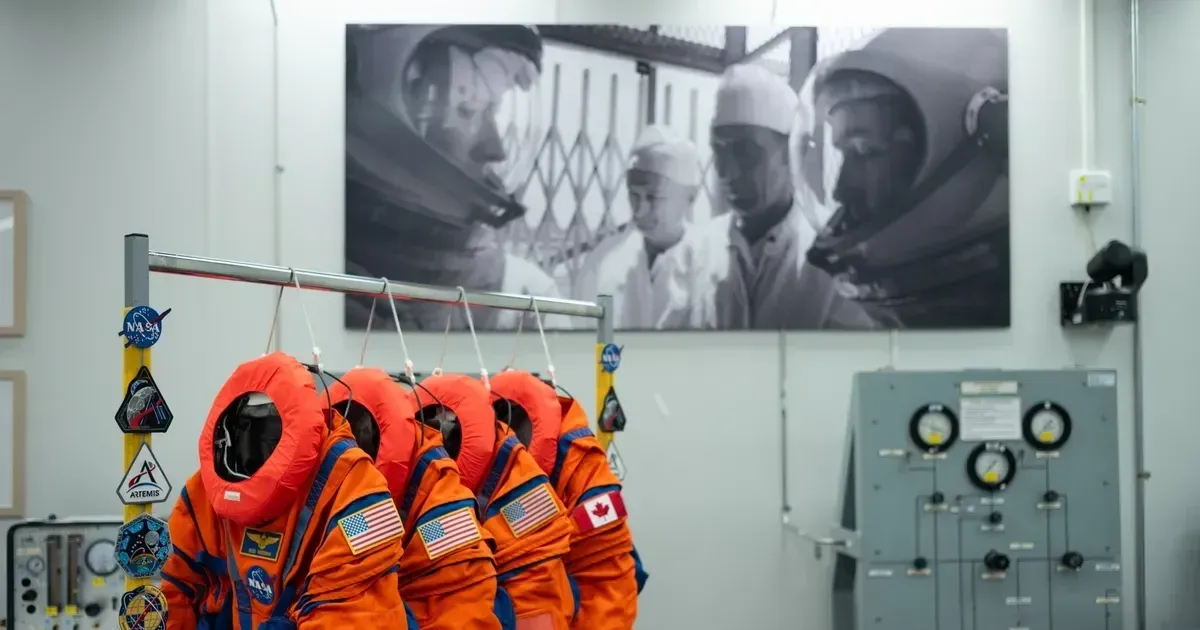
The Orion Crew Survival System suits are awaiting final pressure checks. These orange suits are built to protect the astronauts during launch, reentry and cabin-pressure emergencies, when seconds can decide whether a problem remains survivable.
Canadian astronaut Jeremy Hansen's seat also highlights the international structure of Artemis. Canada's role in deep-space robotics helped secure participation in a mission that extends beyond Earth orbit for the first time for a non-American astronaut.
Lunar Flight Plan
Artemis II will follow a hybrid free-return trajectory around the moon. The path sends the crew thousands of miles beyond the lunar far side before gravity helps pull Orion back toward Earth.
The mission is primarily a systems test. The crew will validate life support, navigation, communications and proximity operations before NASA commits later missions to landing attempts near the lunar south pole.
Launch Pressure
Kennedy Space Center is preparing for heavy crowds, intense security and the enormous acoustic force of the Space Launch System. Pad 39B's water deluge system will release hundreds of thousands of gallons to protect the platform from engine shockwaves.
The stakes are financial as well as symbolic. Artemis II must prove that SLS and Orion can support human flight after years of cost criticism, schedule pressure and political scrutiny.
Pad 39B's sound-suppression system and emergency egress hardware are among the systems engineers must verify before launch. The water system protects the platform and vehicle from acoustic shock, while the egress system exists for the worst case: getting astronauts away from the pad quickly if a fire or other emergency develops.
The mood at the space center is focused rather than celebratory. Artemis II is a test flight, not a routine mission. Life support, carbon dioxide removal, waste handling, communications and navigation will all be watched closely because this is the first crewed use of the system beyond low Earth orbit.
Moonshot Math
Questioning the enormous price tag of human lunar exploration usually invites accusations of luddism, yet the financial reality of the Artemis program demands such scrutiny. We are looking at a projected cost of nearly $100 billion by the time a human boot touches lunar dust again, a figure that seems disconnected from the current economic pressures facing the average taxpayer. While the spectacle of the SLS ignition provides a needed boost to national prestige, one must wonder if we are merely repeating the 1960s at five times the cost.
Robotic missions have proven they can conduct sophisticated mineralogy and mapping for a fraction of the price. The insistence on sending humans is less about science and more about a geopolitical race to claim the high ground of the lunar south pole before our adversaries do. If NASA wants to maintain public support, it must prove that the lunar economy is more than a slide in a PowerPoint presentation. The moon cannot simply be an expensive bus stop on a hypothetical road to Mars.
It must provide real returns in energy, resources, or defense that justify the risk of four lives and the depletion of the national treasury. Anything less is just a very expensive circle in the sky.