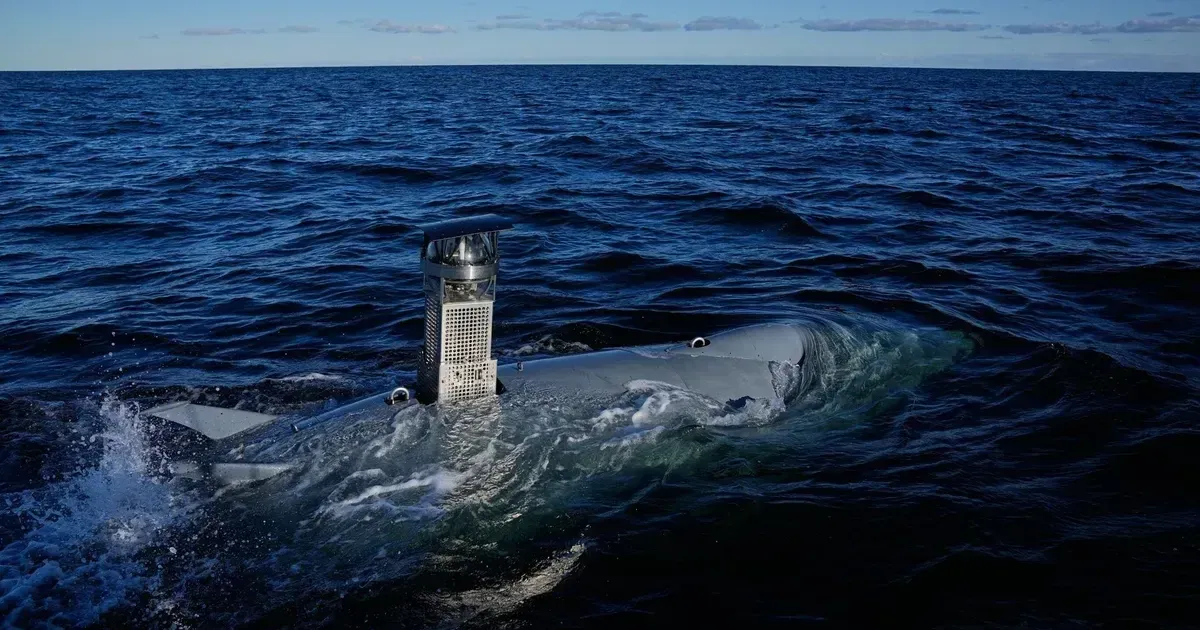
AUKUS defense partners are moving a new underwater drone project toward faster delivery as the alliance tries to strengthen maritime security in the Indo-Pacific. Pete Hegseth, the U.S. defense secretary, discussed the effort on May 30, 2026, on the sidelines of the Shangri-La Dialogue in Singapore. The plan focuses on uncrewed undersea systems that can support surveillance, mine countermeasures, and protection of critical seabed infrastructure.
The United States, the United Kingdom, and Australia are presenting the project as a practical step under AUKUS Pillar II, the part of the pact built around advanced capabilities rather than nuclear-powered submarines. Officials described the undersea program as a way to move more quickly than the long submarine timeline while still adding deterrence in contested waters. The exact investment level and delivery schedule remain less clear than the strategic intent.
Undersea Systems Move Up AUKUS Agenda
Underwater drones matter because much of the competition in the Indo-Pacific happens below the surface. Cables, sensors, submarines, and naval routes all depend on a domain that is difficult to monitor continuously with crewed vessels alone. Uncrewed undersea vehicles can stay in the water for extended periods, collect acoustic data, inspect infrastructure, and help commanders understand movement in sensitive areas without placing sailors in the same level of risk.
Hegseth framed the project as part of a broader push to make AUKUS deliver visible capability rather than remain a diplomatic label. British and Australian defense leaders made similar arguments, emphasizing that shared systems must be useful to all three militaries. That means the project depends on common standards, shared testing, and software that can operate across allied platforms. Without that integration, the drones would add hardware but not the coordinated undersea picture the pact is trying to build.
"The signature project will deliver a suite of highly adaptable multi-mission UUV payloads designed to support undersea operations and maintain our collective advantage in the maritime domain," Hegseth said.
Australia is central to the testing environment because its surrounding waters give engineers a wide range of operating conditions. Trials can expose vehicles to depth, distance, temperature, and communications problems that are hard to replicate in controlled facilities. The Royal Australian Navy's role also ensures that the project is not only a U.S. or British technology export, but a shared operational program shaped by the geography where AUKUS expects the systems to matter most.
Pillar II Offers a Faster Track
AUKUS is best known for the submarine pathway that will eventually provide Australia with nuclear-powered boats. That part of the pact is strategically important but slow, expensive, and politically sensitive. Pillar II is different because it focuses on technologies that can reach service sooner, including autonomy, artificial intelligence, quantum tools, electronic warfare, and cyber capabilities. Undersea drones fit that category because they can be adapted in modules and upgraded without waiting for a new submarine class.
The technical challenge is still substantial. Underwater vehicles cannot rely on the same satellite links used by aerial drones, so communications must use acoustic, optical, or delayed data-transfer methods. Batteries, payload integration, navigation, and secure software all determine whether the systems can operate usefully in real conditions. Defense officials are therefore trying to accelerate delivery while avoiding a rushed deployment that would create unreliable equipment or vulnerable code.
Industrial capacity is another constraint. Scaling undersea drones requires sensors, pressure-resistant materials, batteries, manufacturing space, and trained engineers. The three governments want defense companies to move faster, but those firms still need predictable orders and export rules that allow sensitive technology to move between partners. Recent reforms to AUKUS-related technology sharing are meant to reduce friction, though implementation will decide whether that promise becomes a production advantage.
Pacific Deterrence Drives the Timeline
The strategic reason for speed is the maritime balance in the Pacific. AUKUS partners want more tools to observe and protect choke points, ports, seabed cables, and naval operating areas without relying only on large crewed platforms. Small uncrewed systems do not replace submarines or surface ships, but they can make those forces more effective by widening the sensor network and complicating an adversary's planning.
China was not the only subject of the Singapore conference, but the regional backdrop was unmistakable. U.S. officials used the forum to stress a lasting balance of power in the Pacific, and allied investment in undersea technology fits that message. The value of the drones will depend on whether they can be produced at useful scale, shared securely, and operated as part of a wider network rather than as isolated experimental platforms.
If the project succeeds, AUKUS could show that Pillar II can deliver near-term capability while the submarine plan moves through its longer schedule. If it stalls, critics will point to the gap between announcements and fielded systems. That is why the underwater drone effort carries significance beyond the vehicles themselves: it is a test of whether the alliance can turn sensitive technology cooperation into operational weight in the Pacific. The drone push gives Pacific planners a way to expand surveillance without relying only on crewed submarines or fixed seabed systems. Faster prototyping must still meet the reliability demands of undersea operations, and allied navies will need common software, shared maintenance rules and secure communications before the drones can operate as a network. The next milestone is moving from prototypes to repeatable exercises in which uncrewed systems share trusted data under realistic Pacific conditions, including near Chinese surveillance routes.