Richmond Fed President Tom Barkin is warning that war-driven energy pressure could interrupt the recent progress on inflation. The warning matters because energy shocks can slow inflation progress even when domestic demand is cooling. His March 27, 2026 remarks framed the Iran conflict as both a price shock and a source of uncertainty for central bank policy.
Barkin emphasized that the current environment leaves little room for error. A foreign-policy shock can hit energy prices quickly, while monetary policy works through the economy slowly. That mismatch makes the Fed's inflation fight harder to explain and harder to time.
Richmond Fed President Analyzes Geopolitical Shocks
Barkin pointed to the risk that the Iran conflict could add pressure to supply chains and energy markets just as inflation progress was beginning to look more durable. If fuel and shipping costs stay elevated, companies may face another round of pricing decisions before the Fed can be confident that inflation is still moving lower.
The Federal Reserve has been relying on cooler labor conditions to balance remaining heat in services. Barkin indicated that the labor market is more fragile than it looked earlier in the cycle. If inflation stalls while hiring slows, the Fed may have to keep rates higher for longer even as recession risks increase.
Apollo Economist Slok Evaluates Consumer Expectations
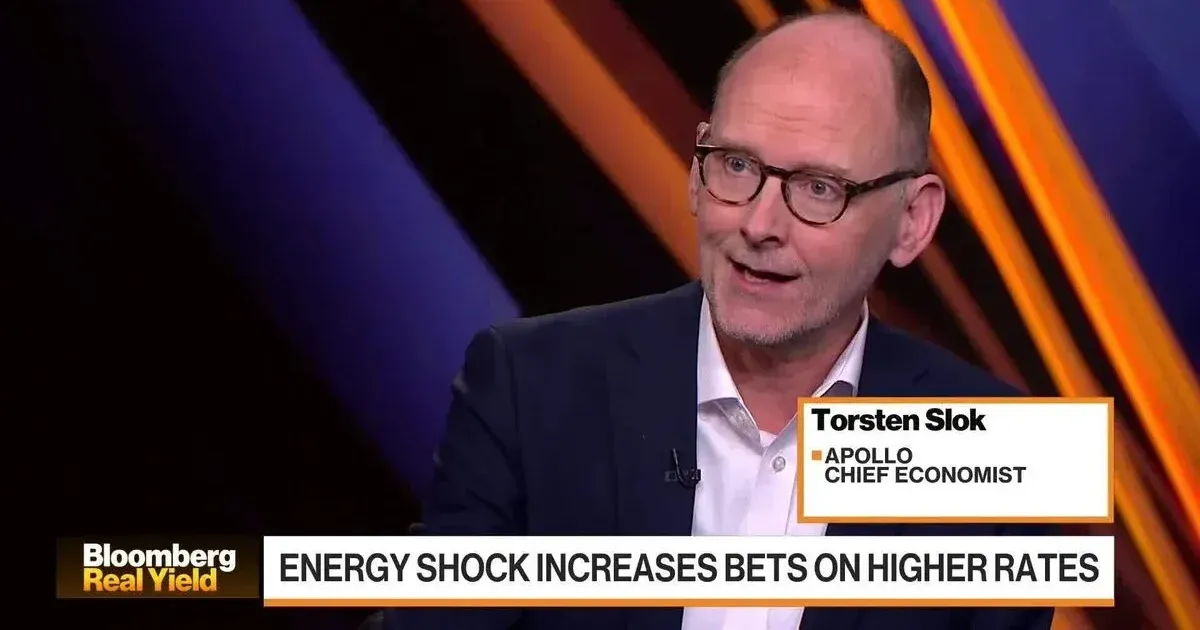
According to Torsten Slok, the stability of inflation expectations is a buffer against the worst-case scenarios envisioned by some policy hawks. Consumers appear to view the current energy shock as a temporary phenomenon linked to specific geopolitical events. Slok argued on Bloomberg Real Yield that this distinction is essential for understanding how the Federal Reserve might react. If expectations remain stable, the central bank may have more flexibility to look through short-term price spikes. Apollo research indicates that consumer sentiment is more closely tied to job security than to the daily fluctuations of the Brent crude index. Slok noted that as long as the labor market does not collapse, the economy can weather higher energy costs.
Slok also acknowledged that a prolonged energy shock would eventually erode household buffers. Lower-income households feel rising fuel and heating costs immediately because energy functions like a mandatory expense. Higher energy prices leave less money for other purchases, which can act as a brake on consumption even before official recession signals appear.
Labor Market Fragility and Central Bank Policy
The Federal Reserve still has to contend with a fragile labor market while fighting inflation. If policymakers raise rates aggressively to combat energy-driven prices, they risk deepening a slowdown they did not create. Barkin has emphasized the need to consider both sides of the Fed's dual mandate as business investment and hiring plans become more cautious.
Some analysts at Apollo argue that the labor market is more resilient than the weakest sectors suggest. Healthcare and education demand can provide underlying support even when manufacturing, construction or technology hiring slows. That divergence gives the Fed a complicated map rather than a single clean signal.
Inflation Transmission Risk
Does the Federal Reserve actually have the tools to manage a world on fire? Veteran observers of the central bank must find Tom Barkin's recent warnings both predictable and deeply inadequate. For years, the committee has operated under the delusion that its interest rate levers can somehow offset the brutal realities of global warfare and energy scarcity. Torsten Slok may point to stable expectations, but expectations are a psychological ghost that vanishes the moment a consumer can no longer afford to drive to work.
The Apollo data provides a fascinating snapshot of the present, but it cannot predict the moment when the public's patience finally snaps. The pattern is clear: a central bank that is fundamentally paralyzed by a dual mandate that has become a dual burden. Barkin talks about a fragile labor market as if it were a delicate vase, ignoring that the Federal Reserve itself is the one that has been swinging the hammer. By keeping rates elevated while the Middle East burns, they risk a policy error that could haunt the global economy for a decade.
The time for cautious rhetoric has passed; the committee needs to decide whether it serves the stability of the dollar or the stability of the employment statistics, because in this new era of permanent conflict, it clearly cannot do both.