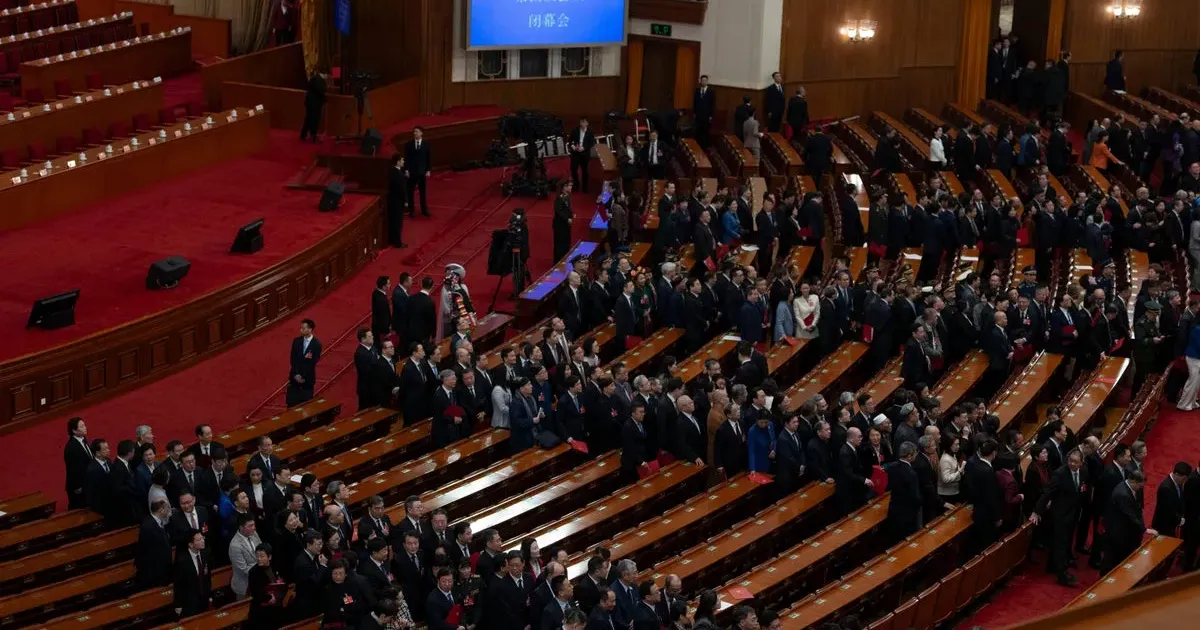
Beijing has turned ethnic unity into a formal legal project, giving the state a stronger framework for shaping identity across China's minority regions. Delegates advanced the law during the March 12, 2026, National People's Congress session, placing cultural policy inside the same political architecture that governs security, education and economic development. The measure is presented by officials as a stability tool. It is understood by critics as another step toward assimilation, especially in regions where local languages, religious traditions and historical memory already face pressure.
What the Law Changes
The law does not operate as a single dramatic order. Its force comes from making ethnic unity a recurring standard for schools, local administrations, cultural institutions and security agencies. That matters because policy language in China often becomes operational through local enforcement. A requirement to promote unity can shape textbooks, public ceremonies, hiring expectations and the political boundaries of acceptable cultural expression. The phrase ethnic unity law also gives officials a legal vocabulary for actions that were previously justified through separate security or development campaigns. It creates a more integrated justification for intervention in daily life.
Minority Regions Under Pressure
The most sensitive question is how the law will be applied in areas with strong non-Han identities. Policies framed as integration can become coercive when communities have little power to reject curriculum changes, language restrictions or religious oversight. Beijing argues that national cohesion reduces separatism and improves opportunity. Dissenting voices counter that stability built through compulsory sameness is not social trust; it is political discipline. The risk is especially high when cultural policy is paired with surveillance technology. Identity, movement, online speech and public worship can all become measurable behaviors inside a security system.
Security and Development Logic
The law also reflects a broader governing pattern. Beijing increasingly treats industrial policy, border security, technology self-sufficiency and cultural identity as connected parts of national resilience. That connection explains why an ethnic policy can sit beside discussions of chips, renewable energy and artificial intelligence. The party's view is that a strong state needs social uniformity as much as economic capacity. For foreign governments, that creates a dilemma. China remains central to supply chains, climate technology and trade, but the same state capacity that makes it economically powerful can also enable intrusive domestic control.
International Response
Western criticism is likely to focus on human rights, but economic dependence will limit the response. Governments may issue statements while companies continue sourcing from regions shaped by the policy environment. That gap between rhetoric and leverage is familiar. Beijing often calculates that foreign capitals will condemn assimilation pressure without accepting the cost of a deeper economic confrontation. The law's importance is not only legal. It signals that Beijing wants cultural identity to be managed as a state-security asset rather than left to local negotiation. A durable country can hold multiple identities without treating them as threats. China's new framework moves in the opposite direction, making unity less a social outcome than an administrative command.
Local Identity Becomes a Security Test
The policy also changes the incentives for local officials. Once unity becomes a measurable legal obligation, cadres have reason to show visible compliance through school programs, public slogans, cultural events and tighter review of religious or linguistic activity. That can turn a broad national law into a dense layer of local pressure. Minority communities may experience the change less as one decree than as many smaller interventions: a classroom text rewritten, a festival reframed, a local language used less often in public institutions or a neighborhood committee asking more questions about private practice.
The long-term risk is that cultural survival becomes dependent on permission. A community can be formally recognized while its actual autonomy narrows year by year. That is why rights groups tend to focus not only on arrests or bans, but on administrative systems that make difference harder to sustain. Beijing's defenders will argue that the state is preventing fragmentation. The harder question is whether unity produced through pressure can remain stable once people no longer believe their own histories have a safe public place.
The technology layer matters because the law also sits inside a country that has built powerful digital governance tools. Education records, travel controls, online speech monitoring and local security systems can reinforce one another when a political campaign is defined as a national priority. That integration makes the policy more durable than a slogan. It allows the state to connect identity, loyalty and behavior in ways that are difficult for local communities to challenge through ordinary legal channels.
The question for outside observers is how to measure harm when the change is gradual. A community may still hold festivals, publish approved materials and appear in state media while losing control over the terms on which its identity is presented. That softer form of pressure can be harder to document than an outright ban.
The policy also affects younger generations most directly. Children educated under a stronger unity framework may learn local heritage through a state-approved lens before they have the language or power to ask what has been omitted. That is why the law should be watched over years, not news cycles. Its consequences will appear in curriculum, local administration, religious practice and the confidence communities have in passing memory to the next generation.
That approach may produce visible order, but it also raises the long-term cost of suppressing difference. The more identity is managed from the center, the more fragile genuine trust becomes.