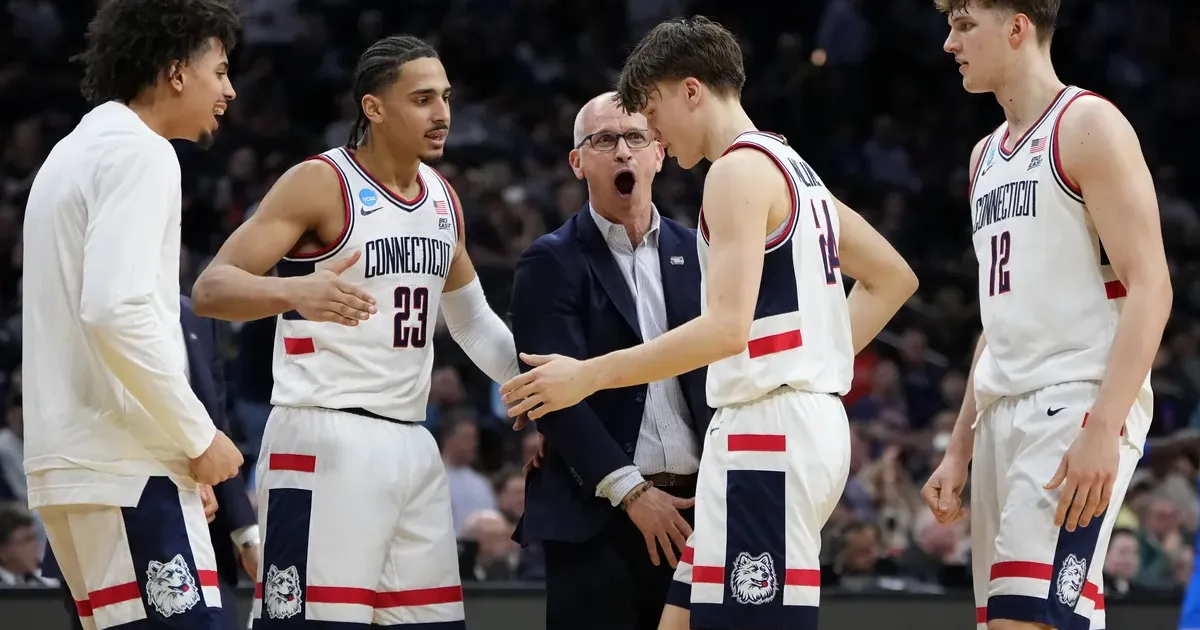
UConn and Duke turned the East Regional into a blue-blood test after both survived difficult Sweet 16 games in Washington. The matchup gives the tournament another familiar brand collision with fresh roster stakes. UConn held off Michigan State 67-63 behind Alex Karaban and Tarris Reed Jr., while Duke advanced past St. John's to set up a regional final loaded with history, pressure and national-title expectations. The pairing also answered a week of talk about whether college basketball's old powers had lost their grip. Rick Pitino had questioned the meaning of blue-blood status, but the bracket delivered a different answer. Programs with elite talent, deep resources and tournament muscle were still standing at the end of the night.
Karaban Steadies UConn
UConn's win was not smooth. The Huskies built a large first-half lead, then watched Michigan State drag the game back into doubt. Karaban's late shot-making and free throws gave Dan Hurley's team enough control to avoid a collapse that would have rewritten the region. Michigan State's rally exposed UConn's vulnerability when its offense stalls. The Spartans forced rushed possessions, found transition chances and briefly made the defending champions look ordinary. The response mattered more than the scare. UConn closed with the calm of a group that has already played deep into March.
Karaban's value is not only scoring. He gives Hurley a player who understands when to slow the tempo, when to attack a mismatch and when to absorb pressure without turning a possession into panic. In a regional semifinal, that judgment can be as important as a box-score line.
The related path through the region, including Duke and Michigan's earlier tournament momentum, kept Washington at the center of a heavyweight bracket.
Duke Holds Its Side
Duke's advance over St. John's gave Jon Scheyer another high-leverage March result and placed the Blue Devils one game from the Final Four. The win leaned on depth, composure and the ability to recover after St. John's turned the game physical. The Blue Devils are no longer operating under Mike Krzyzewski, but the program's machinery remains intact. Recruiting, spacing, defensive length and late-game shot quality still travel well in March. That continuity is why the Duke brand remains more than nostalgia.
Against UConn, Duke will need to protect the paint without allowing Karaban and the Huskies' shooters to dictate matchups. The tactical margin is thin because both teams can punish a single bad switch or a slow rotation. The first five minutes may matter more than usual. UConn wants to turn the game into a possession-by-possession test of physical discipline. Duke wants enough pace to put its athletes in space before the Huskies can load up defensively. If either team controls that tempo early, the other will have to burn adjustments before halftime.
The coaching layer may decide the regional final. Hurley trusts UConn's half-court discipline and late-clock execution, while Scheyer needs Duke to turn athletic advantages into clean early offense. Both teams have enough talent to survive a bad shooting stretch, so the separator may be which bench can steal four stable minutes without allowing the game to tilt.
What the Matchup Means
The regional final is not proof that parity is dead. It serves as evidence that parity has limits when the best-resourced programs also adapt to the transfer portal and NIL era. UConn has become the modern tournament machine; Duke remains the sport's most durable national brand.
The analysis is that the blue bloods are not disappearing. They are changing shape. The schools that survive are the ones able to combine old prestige with modern roster management. UConn and Duke have both done that, which is why their meeting feels less like a throwback than a preview of how power now works in college basketball.
That is the problem for the rest of the field. NIL money and transfer freedom were supposed to flatten the sport, but they also gave the biggest brands more ways to reload quickly. A program with history, television gravity and a proven tournament coach still has advantages that mid-majors cannot manufacture in one hot March run.
Sunday's game will be decided by execution, not mythology. But the mythology will be in the building, and the winner will carry it to the Final Four. The player-development contrast will be just as important as the brands. UConn has turned continuity and role clarity into a competitive weapon, asking veterans to make small decisions under pressure. Duke relies on elite talent organized inside a structure that still expects deep tournament runs. Both approaches are expensive, disciplined and difficult to replicate.
That is why the game carries national interest beyond the two fan bases. It asks whether the current era rewards the best program culture, the best talent pipeline or the team that can blend both for forty minutes. UConn and Duke are close enough in quality that the answer may come from rebounding, foul discipline or one secondary scorer who handles the moment better than expected. It also gives the tournament a clean contrast between UConn's recent title machine and Duke's longer institutional gravity, a contrast casual viewers can understand without needing a full bracket history. That clarity matters in March, when national attention often follows the teams whose identities are easiest to explain.