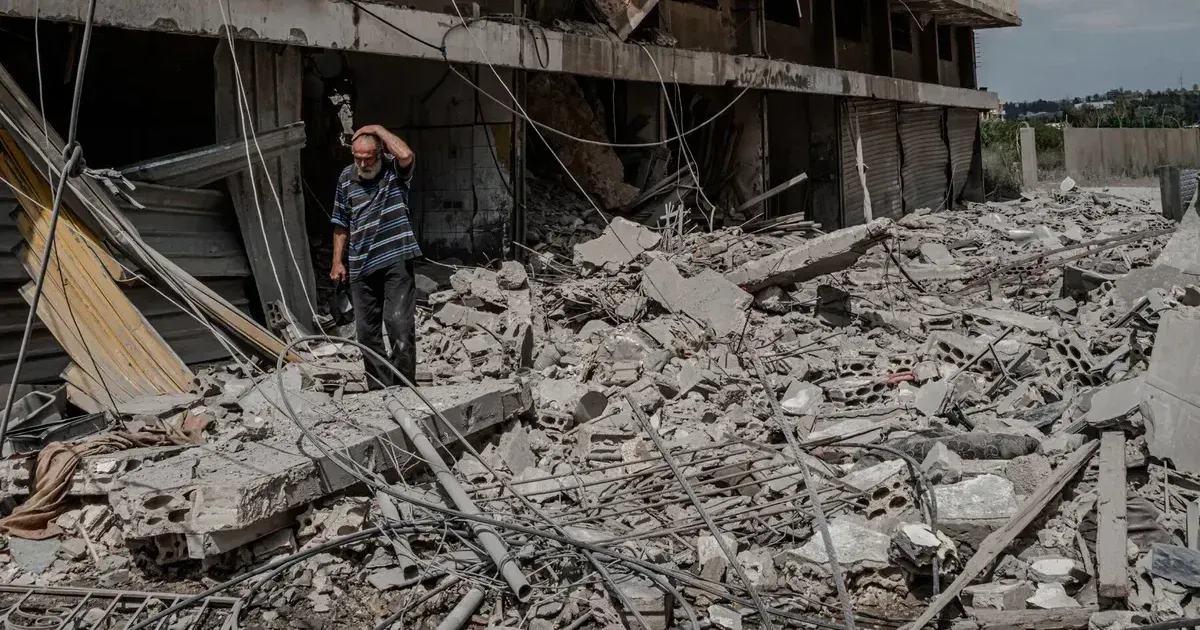
Residents across southern Lebanon are bracing for a longer conflict even as international mediators discuss potential de-escalation frameworks. Public sentiment in Beirut has shifted toward a grim wartime footing as of May 27, 2026, because months of cross-border strikes have destroyed infrastructure and displaced tens of thousands of families. Diplomats from Washington and Tehran have floated several proposals to decouple the Lebanese front from broader regional tensions. These attempts at high-level statecraft, however, find little purchase among a population accustomed to the collapse of international guarantees.
Hope for a swift resolution has largely vanished from the Lebanese political discussion.
Clashes between Israel and Hezbollah intensified this week near the Blue Line, the UN-demarcated boundary between the two nations. Israeli officials maintain that their military operations will continue until northern residents can safely return to their homes. Hezbollah commanders, meanwhile, linked their operations to the ongoing conflict in the Palestinian territories. Local analysts suggest that a deal between the United States and Iran might not automatically translate to a ceasefire in the Levant. This skepticism stems from the localized nature of the grievances and the autonomy of militia groups operating on the ground.
Military activity has moved beyond tactical exchanges into a campaign of attrition that targets logistics and communications. Drones and precision-guided munitions now strike targets deeper into the Bekaa Valley, expanding the theater of war. Each strike on a weapons depot or observation post is met with a volley of rockets aimed at Israeli command centers. Such cycles of violence have become the rhythm of life for those remaining in frontline villages.
Deepening Trenches in Southern Lebanon
Hezbollah fighters have reinforced their positions in the rugged terrain south of the Litani River. Reports from the border show that the militia has used a sophisticated network of underground tunnels to survive aerial bombardments. The resilience of these defense networks has surprised some observers who expected a swifter degradation of capabilities. Israeli forces have responded by intensifying artillery fire and conducting targeted ground incursions to clear launch sites. Every village in the south faces the threat of becoming a battlefield as the frontline remains fluid.
Residents interviewed in the south have repeatedly described foreign negotiations as distant from the sound of shelling, a sign of how little confidence remains in outside guarantees.
Israeli commanders have signaled a readiness for a prolonged engagement to ensure the permanent removal of threats from their northern border. Military planners in Tel Aviv argue that a return to the status quo of 2006 is no longer acceptable for their national security. This perspective implies that even a regional grand bargain between the major powers might not satisfy the security requirements of the Israel Defense Forces. Instead, the military seeks a buffer zone that would require a substantial withdrawal of Hezbollah units. Achieving such a withdrawal through diplomacy alone appears increasingly unlikely given the current tactical landscape.
Diplomatic Disconnect in Beirut
Negotiators from the United States have traveled to Beirut multiple times to meet with Lebanese officials. The primary objective remains the implementation of UN Resolution 1701, which calls for the disarmament of non-state actors in the south. Lebanese government leaders, however, lack the political or military leverage to enforce such a mandate. The executive vacuum in Lebanon, characterized by a long-delayed presidential election, further complicates the state's ability to act as a reliable partner in peace talks. Many citizens view these diplomatic visits as purely performative gestures that ignore the reality of Hezbollah's domestic power.
Foreign capitals remain focused on avoiding a total regional fire that would involve direct American or Iranian intervention. While a deal between Washington and Tehran could theoretically reduce the supply of advanced weaponry to proxy groups, it does little to address the existing stockpiles. The thousands of short-range rockets already positioned in southern Lebanon provide Hezbollah with years of combat capacity. The stockpile ensures that the group can maintain a high-intensity conflict regardless of current shipping lanes or diplomatic shifts. Stability in the Levant has become increasingly decoupled from the progress of nuclear or sanctions-related negotiations.
Economic Ruin and Social Resilience
Lebanese civilians continue to bear the brunt of a dual crisis: a failing economy and a relentless war. The Central Bank of Lebanon has limited reserves to fund reconstruction or support the displaced population. Many families who fled the south now live in overcrowded schools and community centers in the north. These conditions have strained social cohesion as competition for food, medicine, and jobs increases. Poverty rates have spiked in areas that were once the country's agricultural heartland because farmers cannot access their fields near the border.
Infrastructure damage has also hampered the delivery of electricity and clean water to several districts in the Nabatieh governorate. Repair crews often cannot reach damaged transformers due to the constant threat of drone strikes. The lack of basic services has forced even the most resilient residents to reconsider their presence in the south. Instead of a temporary evacuation, many are now preparing for a permanent relocation. Peace, if it ever arrives, will find a landscape that has been fundamentally altered by years of neglect and fire.
Lebanon Cannot Enforce a Deal Written in Washington and Tehran
Historical parallels suggest that border conflicts in Lebanon are rarely solved by external treaties alone. The 1982 and 2006 wars both ended with international resolutions that failed to prevent the eventual re-arming of non-state actors. The cycle of conflict persists because the underlying sectarian and regional tensions remain unresolved. Any new agreement between the United States and Iran would likely focus on maritime borders or nuclear enrichment rather than the detailed security details of the Blue Line. Without a solid enforcement mechanism on the ground, such deals are often viewed as temporary breathers instead of permanent solutions.
The disconnect between high-level diplomacy and tactical reality ensures that the people of Lebanon remain in a state of suspended animation. The risk of a miscalculation leading to a full-scale invasion is high. For the residents of the Levant, the war is not a strategic abstraction but a daily struggle for survival. Peace remains a distant prospect.