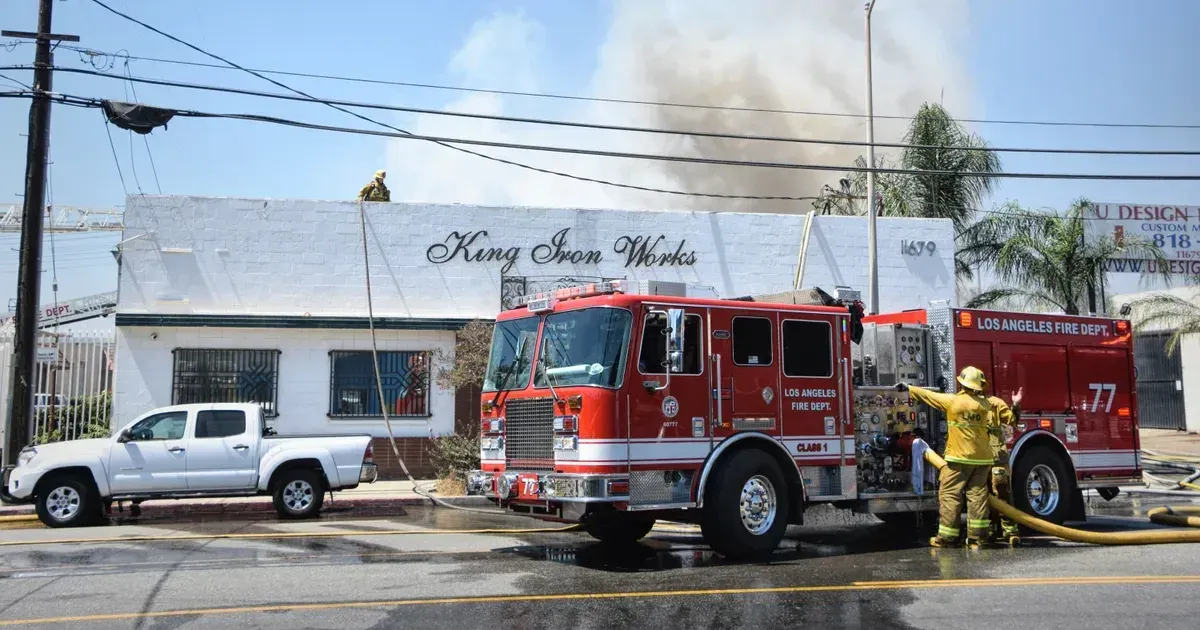
A large warehouse fire in Boyle Heights pushed Los Angeles officials to issue shelter guidance while crews worked through smoke, heat and air-quality concerns. The fire became a public-health question before it was fully contained. Smoke movement, road closures and warning language mattered as much to residents as the condition of the warehouse. Officials issued the guidance on June 18, 2026, as residents sought clarity on safety orders, road closures and possible exposure risks. The emergency also exposed how quickly an industrial incident can become a neighborhood-wide information problem.
The blaze drew heavy emergency response because of the size of the building and the risk that smoke could move into nearby residential and commercial blocks. Officials treated the fire as more than a property loss. The central concern was whether people close to the site could safely remain outdoors while crews attacked the flames. That distinction matters in a dense city, where a single industrial incident can become a neighborhood health event before the structure is fully under control. The faster that risk is explained, the less likely residents are to improvise their own unsafe answers.
Smoke Turns a Local Fire Into a Public Safety Test
The words “shelter in place” change how a neighborhood experiences an emergency. They tell residents that the danger is not limited to the burning structure, but may extend into the air around them. For parents, workers and older residents, that instruction is not abstract; it decides whether windows stay shut, errands are canceled and outdoor time stops.
That is why large industrial fires demand a different kind of public communication. People need to know whether to close windows, avoid travel, keep children indoors and wait for air monitors before assuming the danger has passed. A vague warning can leave residents guessing, especially when smoke is visible but the precise health risk is still being measured.
Boyle Heights sits near freeways, rail corridors and warehouse space, which makes smoke events especially disruptive. A fire in that setting can affect workers, drivers, schools and households far beyond the first alarm perimeter. The neighborhood's geography means emergency orders can collide with commutes, deliveries and school routines in minutes, not hours.
The Los Angeles Fire Department response also has to account for what is inside the structure. Even when the public does not know every material in a warehouse, officials must plan for heat, runoff, collapse risk and chemical exposure possibilities.
Why the Location Matters
Industrial fires are often described in square footage, but the real measure is proximity. A 500,000-square-foot warehouse near homes and busy streets creates a different problem than the same fire in an isolated district. The building's scale matters because it can extend the timeline of the response, keep smoke active longer and complicate the decision about when nearby blocks are safe again.
Residents in nearby blocks do not need dramatic language. They need plain instructions, frequent updates and a fast explanation when an order is lifted or expanded. That is especially true in neighborhoods where past pollution, traffic and industrial use have already made public health a daily concern.
That is where emergency management succeeds or fails. The fireground may be controlled by professionals, but the public-facing side depends on whether people receive information before rumor fills the gap. Clear public guidance also protects firefighters, because fewer people entering the area means fewer rescue problems and less confusion around blocked streets.
The Accountability Starts After the Flames
The immediate job is containment. The harder job begins afterward, when inspectors, property owners and city officials have to explain how a building of that scale became a neighborhood risk. That review should include not only the origin of the fire, but also whether emergency planning around the site matched the density of the community around it.
There will be familiar questions: what was stored inside, whether permits matched actual use, whether inspections were current and whether nearby residents received warnings quickly enough. Those questions are not bureaucratic details. They are the line between a fire response and a public safety system. Los Angeles cannot treat every industrial emergency as a one-day disruption. If warehouse districts sit close to families, schools and transit corridors, safety planning has to be visible before the smoke appears. A city that waits until residents are told to stay inside has already accepted too much risk as normal.