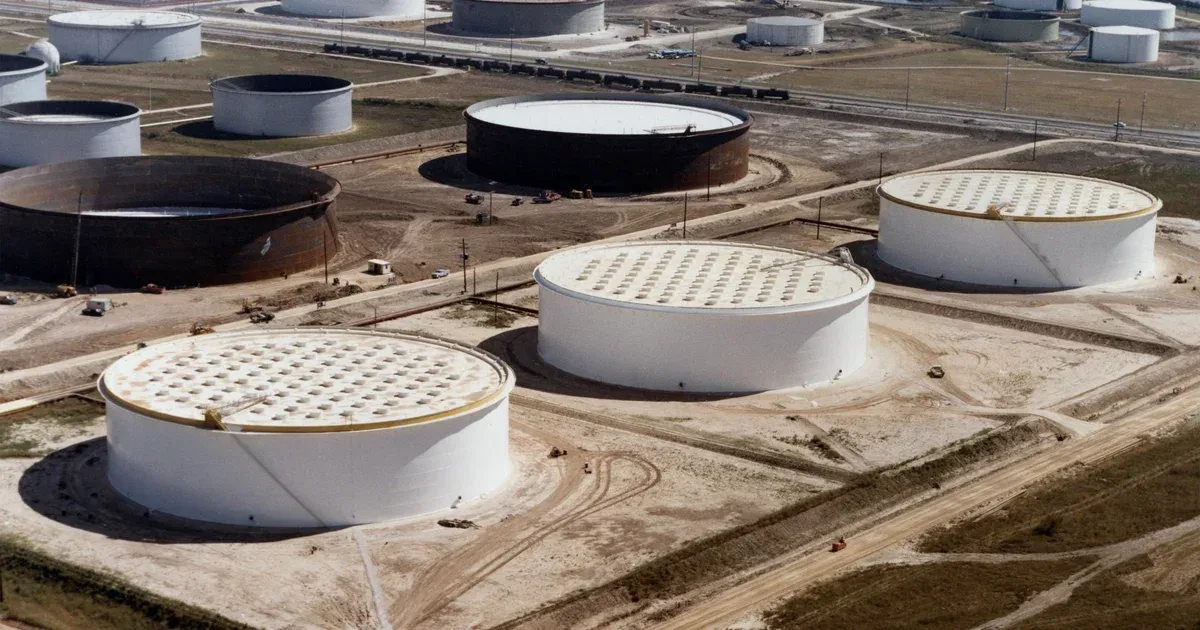
Governments are framing the largest oil-reserve release in history as market relief, but the move exposes how little policy can do while Gulf supply routes remain threatened.
The largest oil-reserve release in history is being framed as market relief, but it also exposes how little policy can do if Gulf supply routes remain threatened.
Oil Reserves Become the Emergency Tool
Tokyo and Berlin finalized plans early Wednesday to discharge millions of barrels from their strategic reserves, responding to severe supply disruptions in the Middle East. This intervention seeks to stabilize a global economy reeling from escalating hostilities in the Persian Gulf. The decision landed on March 11, 2026, as governments tried to calm a market frightened by Persian Gulf disruption. Brent crude futures, which recently touched $100 a barrel, dropped toward $90 as word of the massive release reached trading floors in London and New York. The International Energy Agency requested that member nations authorize a total of 400 million barrels, a volume that dwarfs previous emergency measures.
It represents more than double the amount released during the 2022 energy crisis, setting a new benchmark for international cooperation in the face of military conflict. European capitals are bracing for a prolonged period of energy volatility. France, Italy, and the United Kingdom have already pledged their support for the IEA proposal. These nations view the release as a necessary buffer against the destruction of oil infrastructure in Iran. War in the region has crippled production, leading to fears of a global shortage that could persist for months.
Katherina Reiche, Germany's energy minister, stated on Wednesday that her country would comply with the 400 million barrel target to uphold the principle of mutual solidarity. Berlin's commitment is seen as a major shift for a nation that has historically prioritized long-term storage over short-term market intervention. Energy markets have remained on edge for weeks. Iranian forces recently targeted critical processing facilities and shipping lanes, leading to a sharp spike in transportation costs. These attacks came in retaliation for US-Israeli airstrikes across Iranian territory, creating a cycle of violence that threatens the world's primary oil transit corridor.
While some analysts suggested the market might absorb the initial shock, the scale of the infrastructure damage has made government intervention unavoidable.
G7 Governments Try to Calm Prices
The IEA first proposed this drastic measure during an extraordinary meeting late Tuesday, realizing that private inventories were insufficient to manage the deficit. The math of global energy security is changing. Washington has become one of the most vocal proponents of the 400 million barrel draw. President Donald Trump faces significant pressure to lower fuel prices before the upcoming mid-term elections later this year. High gasoline costs remain a primary concern for American voters, and a coordinated global release provides the administration with a non-military tool to ease domestic economic strain.
European officials familiar with the discussions noted that the United States is prepared to contribute a substantial portion of the total volume, drawing from salt caverns across the Gulf Coast. This massive draw on reserves is designed to flood the market with physical barrels, countering the speculative bets that have driven prices to triple digits. Paris hosted a virtual summit of G7 leaders at 3 p.m. local time to formalize the details of the release. French President Emmanuel Macron organized the call to ensure that Asian and Western powers remained aligned.
Japan and South Korea are particularly vulnerable to Persian Gulf disruptions due to their lack of domestic energy resources. For these nations, the strategic reserve is more than an economic tool; it is a survival mechanism. The IEA itself was established after the 1973 oil embargo to prevent individual countries from being held hostage by regional conflicts. That historical mission is being tested today on a scale never before seen in the organization's history. Previous coordinated releases, such as the 182 million barrels authorized in 2022, focused on offsetting the loss of Russian crude.
The Supply Shock Remains Real
The current situation is more complex because it involves the physical destruction of export terminals and refining capacity. It is not just a matter of rerouting supplies, but of replacing lost volume that may not return for a long time. Experts at the IEA believe the 400 million barrel figure will provide approximately six months of coverage, allowing time for repairs to regional infrastructure or for alternative suppliers to ramp up production. This strategic gamble assumes that the conflict in Iran will not expand into a broader regional war that closes the Strait of Hormuz entirely. History rarely repeats itself with such precision.
Logistical hurdles remain a significant concern for the implementing nations. Releasing 400 million barrels requires sophisticated coordination between pipeline operators, refinery managers, and shipping conglomerates. Most of the reserves are held as crude oil, which must be refined into gasoline, diesel, and jet fuel before it can benefit consumers. Germany and Japan possess some of the most advanced refining complexes in the world, yet even their systems will be pushed to the limit by such a rapid influx of inventory. Still, the alternative of doing nothing was deemed far more dangerous by the G7 leaders.
A sustained price of $100 per barrel would likely trigger a global recession, compounding the existing inflationary pressures felt across the Eurozone and North America. Price stability depends heavily on the perception of scarcity. When the IEA announces a release of this magnitude, it sends a message to speculators that the world's most powerful economies are willing to exhaust their emergency supplies to protect market liquidity.
Why Reserves Cannot Replace Strategy
Will 400 million barrels of crude oil stop a missile? That is the question global leaders are pointedly avoiding as they raid their emergency stores to mask the true cost of a failing Middle East policy. For decades, the West has treated its strategic reserves as a magical safety net, a way to insulate voters from the violent realities of the regions that power their cars and heat their homes. This massive release is a desperate political maneuver, not a coherent energy strategy. It serves the short-term interests of leaders like Donald Trump, who are more concerned with upcoming elections than the long-term integrity of global energy security.
By draining these reserves now, the G7 is effectively disarming itself. If the conflict in Iran intensifies or spreads to the Arabian Peninsula, we will have nothing left in the tank but empty promises and high-minded rhetoric about solidarity. We are trading the security of tomorrow for a slightly cheaper gallon of gas today. It is a cynical bargain that ignores the fundamental truth: you cannot solve a kinetic war with a paper release of oil. The reality is that our dependence on this volatile region has once again left us vulnerable, and no amount of reserve-tapping can change that underlying rot.