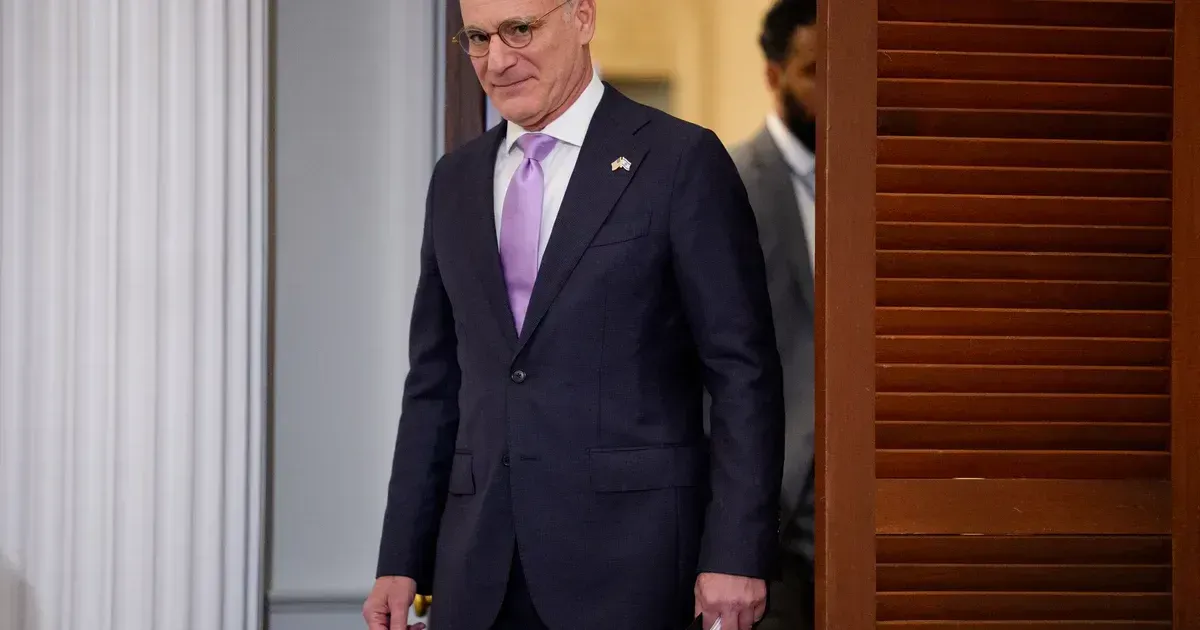
Israeli officials moved to block a central component of a tentative peace agreement brokered by Washington, casting doubt on the immediate future of regional stability. Ambassador Michael Leiter, speaking in an interview with NPR on June 16, 2026, confirmed that his government has no intention of vacating its military positions across the northern border. Tehran concurrently maintains that any cessation of hostilities with the United States hinges entirely on a full withdrawal from those territories.
Negotiations led by the Trump administration produced a framework designed to de-escalate the multi-front conflict, yet the territorial dispute over South Lebanon remains an intractable barrier. Iran's top diplomat stated on Tuesday that the proposed deal requires the removal of Israeli forces as a requirement for formalizing the treaty. Israel quickly dismissed this requirement, asserting that its security presence is necessary to prevent a resurgence of cross-border rocket fire.
Ambassador Leiter characterized the withdrawal demand as a non-starter for the Israeli cabinet. He emphasized that the current military footprint is a buffer against proxy forces that previously occupied the hills overlooking northern Israeli towns. This refusal directly contradicts the optimism expressed by White House officials earlier this week regarding a breakthrough in the Levant.
"Israel is not going to withdraw from South Lebanon," stated Michael Leiter, the Israeli ambassador to the United States.
Iranian representatives have countered that no agreement is valid without the restoration of Lebanese sovereignty. Their top diplomat argued that the United States could not offer security guarantees while its closest ally maintains a foreign occupation. These conflicting red lines have left the peace process in a state of suspended animation, despite the serious diplomatic capital invested by American mediators.
Michael Leiter and the Lebanon Deadlock
Leiter clarified that the decision to stay in the southern regions of Lebanon stems from a tactical assessment of the ongoing threat. He suggested that previous withdrawals only empowered militant groups to fortify their positions closer to the border. Military commanders in Jerusalem have reportedly advised the government that a hasty exit would invite a new cycle of violence within months of a signature.
Washington has struggled to reconcile these security concerns with the demands of the Iranian regime. State Department cables suggest that the White House hoped a phased withdrawal might satisfy both parties. However, the rigidity of the public statements coming from both Jerusalem and Tehran indicates that a middle ground has yet to be identified. The current deadlock suggests that the tentative deal may require a complete overhaul before it can be implemented.
Regional stakeholders are watching the friction with mounting concern. If the deal collapses over the Lebanon clause, the prospect of an expanded war remains a meaningful risk. Diplomats from neighboring countries have urged the Trump administration to seek a third-party monitoring force as a possible compromise, though neither the Israelis nor the Iranians have expressed interest in a UN-style observer mission.
Diplomatic Friction Over U.S. Peace Framework
The proposed treaty was intended to serve as a detailed reset of relations between Washington and Tehran. It included provisions for sanctions relief and maritime security in the Persian Gulf, aimed at stabilizing energy markets. Iran's insistence on the Lebanon withdrawal suggests it views the conflict as a single interconnected theater, whereas the United States has attempted to silo the various points of contention.
Critics of the deal within the Israeli Knesset have urged Prime Minister Netanyahu to ignore the American pressure. They argue that a deal with Iran should not come at the expense of Israel's northern security. This internal political pressure limits the diplomatic flexibility of Ambassador Leiter and his colleagues in Washington, making a concession on the Lebanon issue highly unlikely in the near term.
Tehran's strategy involves using the Lebanon withdrawal as a test for American sincerity. By making it a hard condition, it forces the United States to choose between the success of its peace initiative and the strategic preferences of their primary regional partner. The diplomatic trap has slowed the momentum that characterized the talks throughout early June.
Diplomatic Fallout
Israel’s rejection of the Lebanon withdrawal raises the prospect of a lasting failure in the current peace process. History suggests that high-stakes negotiations often reach a point of maximum tension before a final breakthrough, yet the specific geography of South Lebanon presents a uniquely difficult hurdle. Israel's insistence on a security buffer is more than a bargaining chip; it is a core tenet of its current military doctrine. It creates a binary outcome where either Iran must drop its primary demand or the United States must find a way to guarantee Israeli security without a physical presence.
As the Trump administration pushes for a final signature, it is fighting against entrenched military positions and diminishing political patience.
The deal's fate will likely depend on whether Washington can convince its allies that the risks of peace are smaller than the costs of a perpetual war.