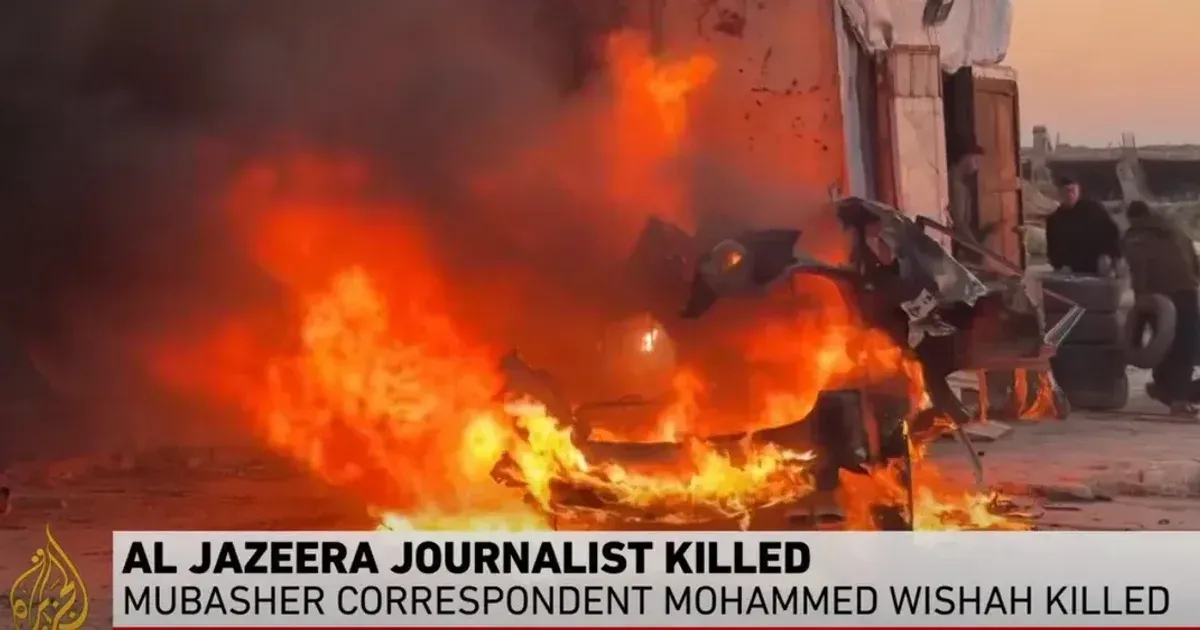
An Israeli drone strike killed Al Jazeera reporter Mohammed, placing journalist safety at the center of a widening debate over military targeting and accountability. The attack added another press casualty to a conflict in which reporters have often worked close to active fire. News organizations said the death underscored the danger facing crews trying to document strikes, displacement and military claims. Field reporters often work with limited protection because the same visibility that identifies them as press can also expose their location.
On April 8, 2026, the strike was reported after a day of intensified operations in Lebanon. By the time officials confirmed the journalist's death, editors and rights groups were already asking whether the crew had been identifiable as press. Those questions matter because international humanitarian law gives journalists civilian protection unless they take direct part in hostilities.
Al Jazeera said its reporter was covering the effects of Israeli operations when the drone attack occurred on April 8, 2026. Israeli officials have not provided a full public explanation of the targeting decision. Without that explanation, the incident is likely to become part of a broader record of disputed strikes on media workers in the region. The absence of timely information also leaves families and editors to reconstruct the event from fragments gathered under dangerous conditions.
Press Safety
Al Jazeera has repeatedly accused Israeli forces of failing to protect journalists in conflict zones. Israel has often responded that its forces target militants and military infrastructure, not reporters. The gap between those positions has widened as more media workers have been killed or injured while documenting the war.
Press crews operate in a difficult space during air campaigns. They need to reach damaged areas quickly, but the same roads may still be watched by drones or artillery units. Protective vests and marked vehicles reduce risk only if military forces recognize and respect those markings in real time.
Journalist safety groups are likely to demand an independent investigation. Internal military reviews rarely satisfy newsrooms or families because the evidence is controlled by the force that carried out the strike. A credible inquiry would need location data, communication records, drone footage and witness testimony. It would also need to establish whether commanders knew a media crew was present before the strike was authorized. If the crew was visible, the question becomes why the strike proceeded; if it was not visible, the question becomes whether surveillance and communication protocols were adequate for a crowded civilian environment.
Press freedom groups said journalists must not be treated as combatants for documenting the effects of war.
Targeting Questions
The central issue is whether the strike resulted from misidentification, intelligence failure or a broader tolerance for risk near media crews. Each possibility carries a different kind of responsibility. A mistake may still reveal weak procedures, while a pattern of strikes near journalists raises deeper concerns about operational discipline.
Israel Defense Forces commanders face pressure to explain how targets are approved when civilians, aid workers or reporters are nearby. Modern drone warfare can create an assumption of precision, but precision depends on accurate intelligence and clear rules of engagement. If the target file is wrong, the weapon's accuracy does not prevent civilian death.
For Al Jazeera and other outlets, the death is also a warning about access. If reporters cannot safely reach conflict zones, the public record becomes dependent on official footage, military briefings and partial accounts. That makes independent reporting more important, not less. In conflicts where each side releases selective evidence, reporters on the ground remain one of the few checks on official narratives.
Accountability Gap
The killing will likely increase diplomatic pressure on Israel from governments that publicly support press freedom while also backing Israel's security concerns. Those governments often call for investigations, but follow-through is inconsistent. Families of killed journalists frequently wait months or years for answers that never become public.
The wider conflict has already produced competing claims about casualty figures, military sites and civilian harm. Reporters are essential because they test those claims against observable conditions on the ground. When journalists are killed, the information environment becomes easier for every armed actor to manipulate.
Mohammed is now part of that larger debate. His death is not only a media story; it is a test of whether combatants can be forced to account for the people who document war. Without transparent investigation, the next press crew will enter the field with the same unanswered risk. Editors will also have to decide whether sending teams into strike zones remains defensible when the rules appear unclear. The result would be a quieter battlefield for the public, but not a safer one for civilians. Accountability also affects future military behavior: if a press death produces no public explanation, commanders have little external incentive to adjust procedures before the next operation. That is why media organizations frame investigations as a safety measure, not only a search for blame.