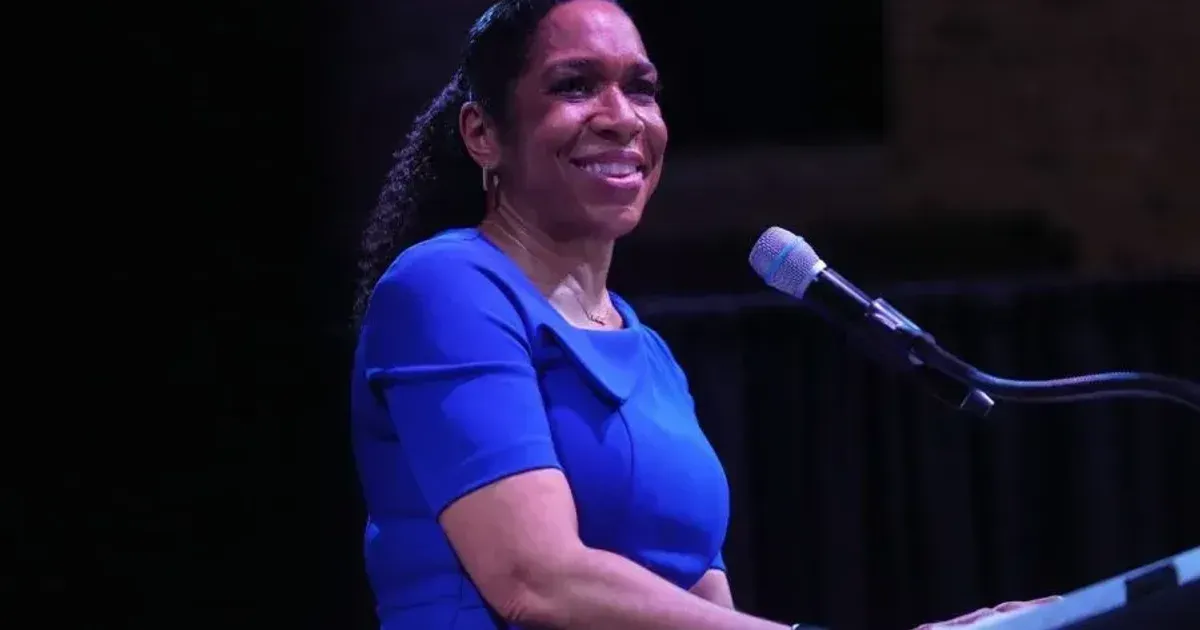
Juliana Stratton claimed victory Tuesday night in a contentious Democratic primary for the U.S. Senate seat vacated by retiring Minority Whip Dick Durbin. Stratton, the current lieutenant governor, overcame a major fundraising gap to defeat Representative Raja Krishnamoorthi. Voters in Chicago and downstate Illinois favored a candidate backed by the state political establishment over an influx of corporate and special interest cash. Her victory places her on a path to become the second Black woman nominated to the Senate from Illinois, following Carol Moseley Braun. Public polling consistently showed a tight race until the final forty-eight hours when a major ad blitz by local allies moved the needle. Stratton now enters the general election as the clear front-runner to join the upper chamber. Political observers spent the evening dissecting a contest defined by heavy outside spending and deep intraparty fissures. While Representative Raja Krishnamoorthi commanded a deep war chest, his financial advantage did not translate into a majority at the ballot box. Early returns from Cook County provided Stratton with a lead she never relinquished during the night. Meanwhile, the Democratic party must now reconcile internal divisions that surfaced during the primary. Several members of the Congressional Black Caucus initially backed Representative Robin Kelly, citing concerns that a split vote would benefit a candidate from outside the community. These warnings highlighted a rare moment of public disagreement between federal lawmakers and the statehouse leadership in Springfield.
Pritzker Spending and Stratton Campaign Strategy
Governor JB Pritzker exerted notable influence over the primary outcome by deploying his considerable political and financial resources. Illinois Future PAC, an organization heavily funded by Pritzker, injected $11.8 million into the race during the final weeks. This capital funded a barrage of television advertisements that simultaneously strengthened Stratton and attacked Krishnamoorthi for his ties to corporate donors. By contrast, Krishnamoorthi relied on a more traditional fundraising model that tapped into his existing federal campaign accounts. Total spending among all Democratic candidates exceeded $50 million, making it one of the most expensive legislative primaries in the state's history. This high price tag reflects the perceived value of an open Senate seat in a safe Democratic stronghold. For instance, the Stratton campaign focused its messaging on immigration reform and aggressive opposition to the former Trump administration. She frequently called for the abolition of Immigration and Customs Enforcement, a position that drew sharp criticism from her more moderate opponents. These policy stances helped her consolidate support among the progressive wing of the party despite her status as an establishment incumbent. Still, the campaign did not proceed without personal friction. Stratton faced intense scrutiny after claiming the late Reverend Jesse Jackson planned to endorse her before his passing last month. The Jackson family issued a public dispute regarding this claim, which Krishnamoorthi used in a series of late-stage attack ads. Voters appeared to look past the controversy as the Lieutenant Governor maintained her leads in urban precincts.
Cryptocurrency Influence and Primary Ad Wars
Heavy outside spending from cryptocurrency interest groups failed to derail the Stratton campaign. Super PACs backed by digital asset firms poured nearly $10 million into the primary, primarily targeting Stratton through negative advertising. These groups viewed Krishnamoorthi as a more favorable voice for their industry in Washington. Yet the backlash against this corporate spending may have inadvertently aided Stratton's narrative of being an independent fighter. She frequently highlighted the source of the attack ads during town halls and debate performances. This strategy allowed her to frame the election as a choice between a local leader and out-of-state financial interests.
Democrats are now all but certain to elect another Black woman to the U.S. Senate after Lt. Gov. Juliana Stratton won Tuesday’s bitter and expensive primary in Illinois.
Anti-Stratton messaging focused heavily on her record in Springfield and her close alliance with the governor. Opponents argued that her move to the Senate would simply extend Pritzker's reach into the federal government. But these arguments failed to gain traction with a base that remains largely supportive of the governor's agenda. In fact, the intersection of AIPAC and crypto spending created a complex political environment that baffled many local analysts. Both groups spent heavily to influence various Illinois primaries, yet their success rate was mixed at best. Stratton’s survival against these well-funded adversaries suggests that traditional retail politics and state-level endorsements still carry notable weight.
November Outlook for Republican Don Tracy
Money alone could not bridge the gap between Krishnamoorthi and the state's dominant political machine. Representative Kelly finished in a distant third place, failing to ignite the same level of enthusiasm that propelled her to the chairmanship of the state party years ago. Her campaign suffered from a lack of consistent television presence compared to the two front-runners. In turn, her supporters are now expected to consolidate behind Stratton for the general election.
But the focus now shifts toward Don Tracy, the former chair of the Illinois Republican Party, who will face Stratton in November. Tracy enters the race as a major underdog in a state that has not elected a Republican to the U.S. Senate since 2010. He is expected to focus his campaign on the state's fiscal issues and the perceived overreach of the Pritzker administration.
And yet the Republican challenge remains formidable due to the potential for voter fatigue. Democrats have held both Senate seats and every statewide constitutional office for years. Tracy intends to argue that one-party rule has led to stagnation, though he faces a steep climb in the heavily Democratic Chicago metropolitan area.
So the primary results confirm that the Illinois Democratic Party remains firmly under the control of its current leadership. The failure of outside money to unseat a Pritzker-backed candidate reinforces the strength of the governor's political infrastructure. National observers are already looking at this race as a bellwether for how establishment candidates will perform against insurgent spending in the 2026 midterms.
One clear outcome of the night is the continued diversification of the Senate. If Stratton wins in November, she will join a small group of Black women who have served in the chamber. The prospect was a major motivator for turnout in diverse neighborhoods across the state.
The primary was a test of whether a self-funded governor could hand-pick a successor for a retiring legend like Durbin. The voters provided an affirmative answer. Stratton’s victory confirms that the alliance between the governor’s mansion and the state’s political organizations is the most powerful force in Illinois politics. Illinois election officials reported high turnout in several key precincts, indicating that the expensive ad campaigns succeeded in engaging the public. The focus of the Stratton campaign will now turn to fundraising for the general election to ensure no late-stage Republican surge occurs.
The state's Republican Party has struggled to find a consistent message that connects with both rural voters and suburban moderates. Without a major shift in the political climate, Stratton appears set to cruise to a victory in November. Her campaign will likely continue to lean on the same coalition of labor and urban voters that delivered this primary win. The Republican strategy will involve highlighting the controversy surrounding the Jesse Jackson endorsement. Tracy has already released a statement questioning Stratton's integrity regarding those claims. These attacks are unlikely to sway a significant portion of the Democratic base in such a polarized environment.
November Outlook
Stratton leaves the primary with momentum, but the general election will test whether Democratic unity follows an expensive intraparty fight. Republicans need an opening beyond spending complaints if they want the race to become competitive.
The blunt lesson is that outside money can distort a primary, but it cannot always overpower a machine that knows its voters. Stratton leaves with establishment force behind her and a general-election map tilted heavily in her favor. The question now is whether that same machine can turn victory into unity after a primary that exposed how expensive Democratic succession politics has become.