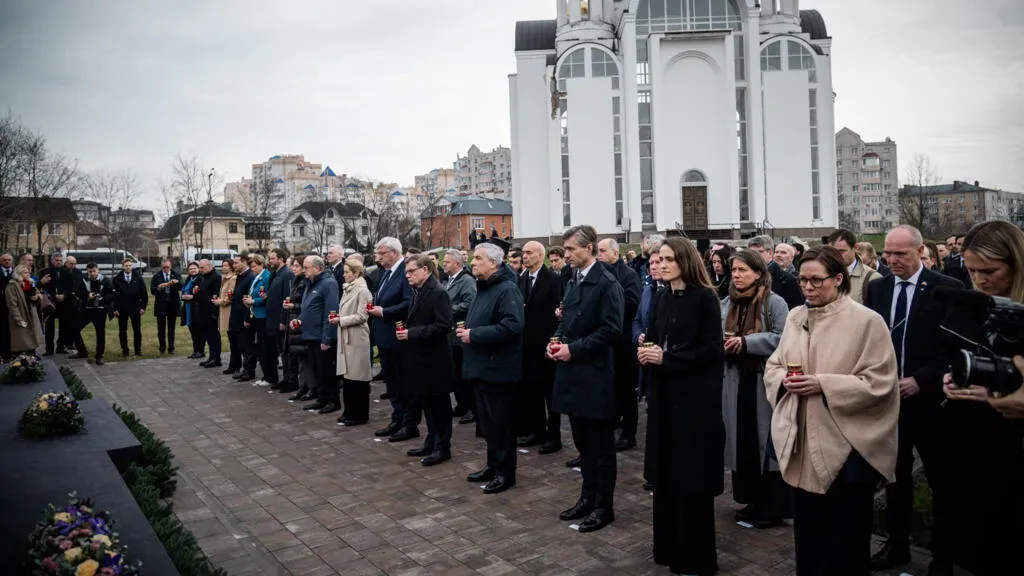
Kaja Kallas, the European Union's top diplomat, stood in the quiet streets of Bucha to honor victims of the massacre that redefined the continent's security architecture four years ago. Standing alongside a delegation of foreign ministers, Kallas walked through the Kyiv suburb where the discovery of civilian casualties in 2022 first galvanized global outrage. These officials arrived at a moment of heightened political friction within the European bloc, as members attempt to reconcile commemorative gestures with practical military assistance. By March 31, 2026, the anniversary had become a test of European memory and military resolve. Flowers were laid at the memorial site where hundreds of residents were interred following the retreat of Russian forces. Silence fell over the group as names of the deceased were read aloud under a grey spring sky.
Memory of the 2022 occupation remains visceral for those living in the reconstructed neighborhoods of the town. Russian military units occupied the area for several weeks during the initial phase of their invasion, leaving behind a trail of destruction that investigators later classified as evidence of war crimes. When Ukrainian forces reclaimed the territory, they discovered 458 bodies in various states of execution and neglect. Some victims lay in the middle of residential streets, while others were found in shallow pits behind a local church. Many of the dead included the elderly and children, according to forensic reports released in the years following the liberation.
Ukraine continues to use the anniversary as a platform to demand more sound defense systems from its Western neighbors. President Volodymyr Zelenskyy has frequently cited the events in this suburb as a primary reason why territorial concessions are not a viable option for his administration. Security at the event was noticeably tight, with anti-aircraft batteries stationed on the outskirts of the city to prevent disruptions from ongoing drone incursions. Diplomatic sources in Kyiv indicate that the symbolic nature of the visit is intended to project a unified front to Moscow. Despite the solemnity of the occasion, the underlying reality of European politics cast a shadow over the proceedings.
Bucha Remembrance and the Legacy of Occupation
Local residents gathered at the central memorial to share stories of survival and loss during the occupation. Witnesses described weeks spent in damp basements without heat or running water while soldiers patrolled the streets above. One survivor noted that the psychological scars of the occupation are far more difficult to repair than the shattered windows and burned-out apartment blocks. Reconstruction efforts have replaced much of the physical damage, but the presence of the European Union ministers was a reminder that the world has not forgotten the events of April 2022. Several ministers spoke privately with families who lost multiple generations during the massacre.
The European Union stands with the people of Ukraine not just in memory of the atrocities committed in Bucha, but in the ongoing fight for a future defined by sovereignty and law.
Evidence gathered by international prosecutors in Bucha remains a foundation of the case against the Russian leadership at the International Criminal Court. Investigators used satellite imagery, intercepted communications, and drone footage to piece together a timeline of the killings. These records show that many civilians were targeted while attempting to flee the town in marked vehicles. Forensic teams identified dozens of individuals who had been bound and shot at close range. Such findings moved the international community to implement some of the harshest economic sanctions in modern history against the Russian Federation.
Kaja Kallas Navigates European Union Aid Deadlock
Hungary has become the primary obstacle to the latest multi-billion dollar aid package intended for the Ukrainian military. While Kallas used her visit to project strength, the internal divisions within Brussels are becoming increasingly difficult to mask. Prime Minister Viktor Orban has consistently used his veto power to stall financial transfers, citing concerns over his own nation's economic stability and energy security. This political gridlock has left several Ukrainian artillery units reporting ammunition shortages at the front lines. Kallas acknowledged these challenges during a brief press conference held near the Bucha memorial site.
Negotiations in Brussels have reached a stalemate over the specific conditions of the funding. Some member states argue that the aid should be tied to stricter transparency measures, while others believe that the urgency of the conflict outweighs administrative concerns. Kallas is reportedly working on a workaround that would allow willing nations to pool resources outside of the standard union framework. Such a move would be unmatched and could potentially fracture the collective bargaining power of the bloc. Meanwhile, the Kremlin has used these delays to strengthen its own industrial production and offensive capabilities.
Forensic Evidence and the Ongoing Search for Justice
Justice remains an elusive concept for the families of the victims as the legal process moves at a glacial pace. The International Criminal Court has issued several warrants, but the likelihood of suspects facing trial in The Hague stays low while they remain on Russian soil. Ukrainian prosecutors have independently identified over a thousand suspects involved in the Bucha atrocities through facial recognition and witness testimony. Many of these individuals have since been redeployed to other sectors of the front or have returned to Russia. Local authorities have established a permanent archive to preserve the testimonies of every surviving resident.
Efforts to digitize the evidence have allowed researchers from around the world to analyze the patterns of the occupation. This database includes thousands of photos, ballistic reports, and GPS coordinates of where every body was recovered. The goal is to create an irrefutable record that prevents historical revisionism in the decades to come. Experts suggest that the Bucha investigation is the most documented war crimes inquiry in history. Every shell casing and piece of shrapnel found in the soil has been cataloged to assist in future reparations claims. The town now is a global center for the study of modern conflict and civilian protection.
For Ukraine, Bucha remains a diplomatic reference point because it gives concrete names and places to a war that can otherwise become abstract in European budget debates.
Why Bucha Still Shapes Aid Politics
The Bucha anniversary still matters because it turns military aid into a moral test for European governments. Leaders can debate delivery schedules, but the documented killings keep the war tied to civilian protection and accountability.
That pressure is also why the Hungarian veto carries wider consequences. A stalled package does not only slow equipment flows; it signals whether the European Union can sustain a shared security position when domestic politics cut against consensus.