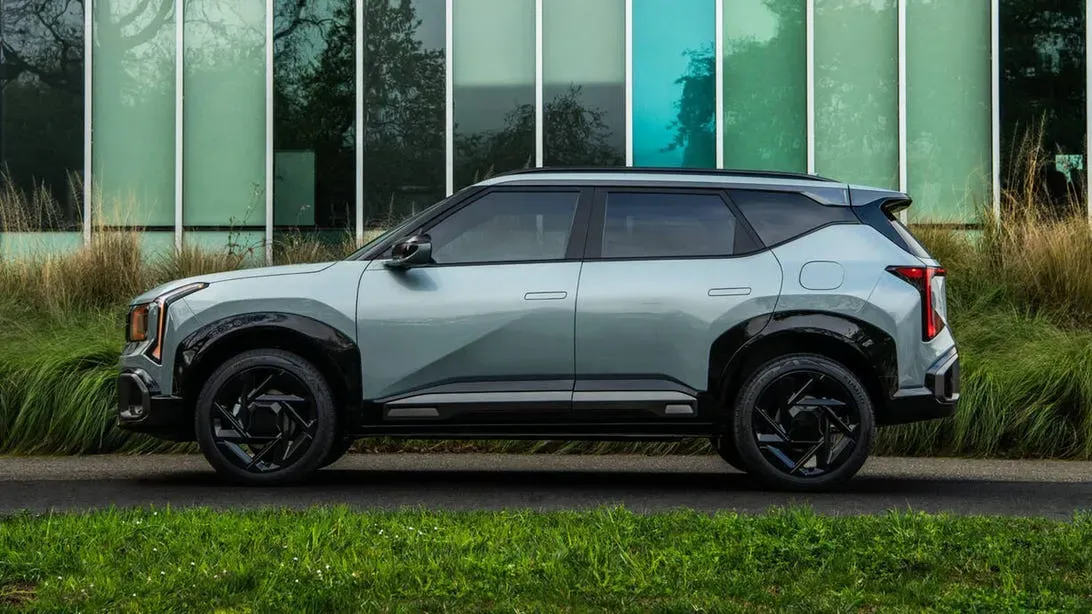
Kia's New York Auto Show message was not that every small-SUV buyer is ready for the same powertrain. It was the opposite. The redesigned Seltos and the 2027 EV3 let Kia speak to two nearby but different customers: one who wants better efficiency without changing daily habits, and one who is ready to make an electric compact crossover the main family vehicle.
The dual approach is commercially sensible. U.S. buyers still like small crossovers because they promise upright seating, useful cargo space and easier parking than larger SUVs. But the market is not moving into EVs at one speed. Charging access, lease prices, tax-credit rules, home parking and road-trip comfort still divide households. Kia's answer is to keep the Seltos familiar while using the EV3 to lower the size and price barrier for electric shoppers.
The Seltos Has to Stay Practical First
The Seltos has worked because it gives buyers SUV shape without forcing them into a bigger and more expensive class. A second-generation model can add room, screens and stronger design links to Kia's newer lineup, but it cannot lose the straightforward value that made the nameplate useful.
The hybrid version is important for that reason. A hybrid small SUV asks less of the buyer than a full EV. There is no home-charger decision, no public-charging planning and no change in road-trip behavior. For commuters facing fuel-price swings, the appeal is practical rather than ideological: lower consumption in traffic, familiar refueling and a cabin that still has to handle school runs, errands and weekend luggage.
Technology Needs to Serve Daily Use
Kia's newer interiors lean on wide displays, cleaner dashboards and a design language tied to its electric models. The newer interior can make the Seltos feel more expensive than its class position, especially if the software is quick and the driver-assistance package feels polished.
The risk is overcomplication. Small-SUV buyers still notice visibility, cupholders, climate-control access, rear-seat space and whether the cargo floor works with real bags. Driver assistance also has to feel calm in ordinary traffic. Lane support, blind-spot monitoring and collision warnings are valuable only if they reduce stress rather than add another layer of alerts.
The EV3 Gives Kia a Smaller Electric Entry
The EV3 has a different job. Kia's official New York material positioned the 2027 EV3 as the most attainable model in its growing EV lineup, with U.S. availability planned for late 2026 and five trims listed: Light, Wind, Land, GT-Line and GT. Car and Driver reported two battery choices, 58.3 kWh and 81.4 kWh, with the long-range version targeting up to 320 miles.
A smaller entry matters because the U.S. EV market has leaned heavily toward larger crossovers, trucks and premium vehicles. A smaller EV that still offers usable range can attract buyers who like the EV6 or EV9 idea but do not need the size or price. The EV3's task is to make electric driving feel normal in a segment where many buyers still compare monthly payment, warranty, charging convenience and cargo space before they compare acceleration.
Affordability Will Decide the EV3's Real Reach
Kia has not solved the market simply by showing a smaller EV. Pricing will decide whether the EV3 becomes a genuine volume choice or another interesting model that shoppers admire without signing. Car and Driver estimated pricing around the mid-$30,000s, with official figures expected closer to launch. The estimate leaves Kia with little room to drift upward.
Range and charging claims will also need final EPA and real-world confirmation. A 320-mile target is strong for the class, but buyers will measure the car against winter range, highway efficiency, insurance, lease support and charger reliability. A compact EV has to be affordable on paper and easy to live with after the first month.
Kia Is Building a Bridge Instead of Forcing a Leap
The Seltos and EV3 work best as a pair. One keeps buyers inside a familiar gasoline-hybrid habit loop. The other offers a lower-cost path into Kia's electric design and software ecosystem. The paired lineup lets dealers meet different comfort levels in the same showroom rather than treating the transition as an all-or-nothing choice.
The paired strategy is stronger than a single dramatic EV pitch. The small-SUV customer is pragmatic. Some households want maximum fuel flexibility. Others want to leave gasoline behind if the price, range and charging case is good enough. Kia is trying to keep both groups close to the brand while the market sorts itself out.
The Strategy Still Comes Down to Price Discipline
The danger is that both models climb too high. If the Seltos hybrid prices near larger crossovers, value shoppers will look elsewhere. If the EV3 loses its attainable positioning, it will struggle against lease deals on bigger EVs and discounted gasoline SUVs. Kia's design and warranty reputation help, but they do not cancel payment math.
The strategy is to keep the Seltos honest and the EV3 genuinely approachable. Kia does not need every small-SUV buyer to electrify at once. It needs to make sure that whichever direction the buyer moves, hybrid or electric, the brand has a credible answer waiting in the same part of the showroom.