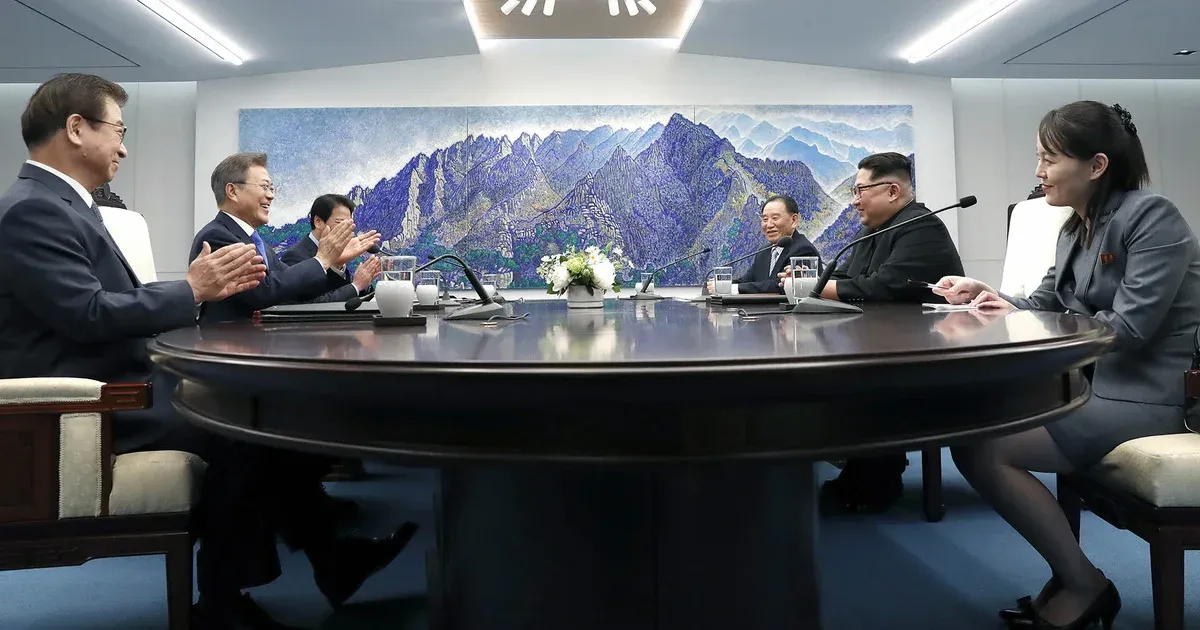
Kim Yo-jong's warning to South Korea added another layer of risk to an already tense security environment on the peninsula. Her statement framed Seoul's military activity as provocation and signaled that Pyongyang is prepared to answer pressure with sharper threats.
The message fits a familiar pattern of calibrated pressure. The warning emerged on April 7, 2026, as regional governments watched for signs that rhetoric could move into military signaling. The key issue is not only what North Korea says, but whether communication channels remain open enough to prevent misreading.
Kim Yo-jong Targets Seoul with New Ultimatum
Pyongyang relies on the voice of the leader's sister to convey its most aggressive positions without committing the supreme leader to an irreversible military path. This specific communique targeted the defensive posture of the Yoon administration, which the North perceives as an existential threat. Military analysts observe that the rhetoric coincided with the deployment of advanced surveillance assets along the Northern Limit Line. Such movements often precede physical demonstrations of force, including short-range ballistic missile tests or artillery drills. Previous records show that Kim Yo-jong utilizes these warnings to justify subsequent violations of maritime boundaries. The Korean People's Army maintained high alert status throughout the duration of the announcement.
Diplomatic channels remain largely frozen between the two capitals as communication hotlines have seen no activity since the start of the year. South Korean officials clarified that their defense readiness remains unchanged despite the verbal escalation. By contrast, the North Korean official cited by Yonhap News emphasized that the warning was explicit and intended to provoke a reconsideration of current regional policies. Observers in Washington suggest that the timing relates to shifting domestic priorities within the Kim regime. Kim Jong-un has recently focused on domestic agricultural reforms while his sister handles the external threat environment. Satellite imagery captured increased vehicle movement at the Mirim Parade Training Ground over the weekend.
“The statement issued by state media is a clear warning to the puppet regime in the South,” a North Korean government official said.
Security forces in Seoul increased their monitoring of electronic signals originating from the northern military command centers. Defense Minister Shin Won-sik previously stated that any direct provocation would meet an overwhelming response from the combined forces of the alliance. However, the psychological impact of repeated warnings often creates a climate of uncertainty in the global markets. Investors tracked the KOSPI index, which saw a marginal dip following the news cycle on Tuesday. Pyongyang continues to leverage its rhetorical capacity to influence the political discussion within the South. National security advisers met in the Blue House to discuss the potential for localized skirmishes. The naval fleet in the Yellow Sea received orders to maintain a five-mile buffer from contested waters.
Tensions on the peninsula typically peak during the spring months when training cycles overlap. Military observers noted that the current warning mentions specific geographic coordinates for the first time in several years. This localized detail suggests that the North may be planning a specific kinetic demonstration near the border. Seoul responded by moving additional self-propelled howitzers to the Gyeonggi province. Experts believe the North is testing the resolve of the current southern administration ahead of the upcoming legislative cycle. Intelligence agencies in Japan confirmed the increase in radio traffic between northern artillery units. The 7th Infantry Division of the South Korean Army conducted an unscheduled readiness drill on April 7, 2026.
Nuclear-capable assets located in the North are reportedly under the direct supervision of the tactical missile command. Reports from the International Atomic Energy Agency suggest that enrichment activities at the Yongbyon facility have not decelerated. Pyongyang views these warnings as a legitimate tool of statecraft designed to secure concessions from the international community. South Korean civic groups expressed concern over the possibility of a miscalculation leading to an unintended conflict. Authorities in the border town of Paju advised residents to familiarize themselves with shelter locations. The North Korean official emphasized that the current stance is a direct consequence of southern aggression. Tactical units in the North were seen covering their mobile launch platforms with camouflage netting.
Communication between the two Koreas has historically relied on a cycle of provocation and de-escalation. Kim Yo-jong is the primary designer of this strategy, often alternating between offers of dialogue and threats of destruction. The latest warning avoids the usual flowery metaphors of northern propaganda, favoring instead a cold, professional tone. Analysts at the Sejong Institute noted that this linguistic shift indicates a more serious intent. South Korea must now decide whether to ignore the rhetoric or adjust its joint exercise schedule to avoid further friction.
Deterrence Depends on Open Channels
Deterrence requires strength, but it also requires enough contact to understand what the other side is signaling. When warnings become more personal and more public, the margin for interpretation narrows.
That is why the channel itself matters. South Korea and its allies can maintain readiness while still preserving routes for crisis messages, because silence during a confrontation can make every movement look more dangerous than intended.