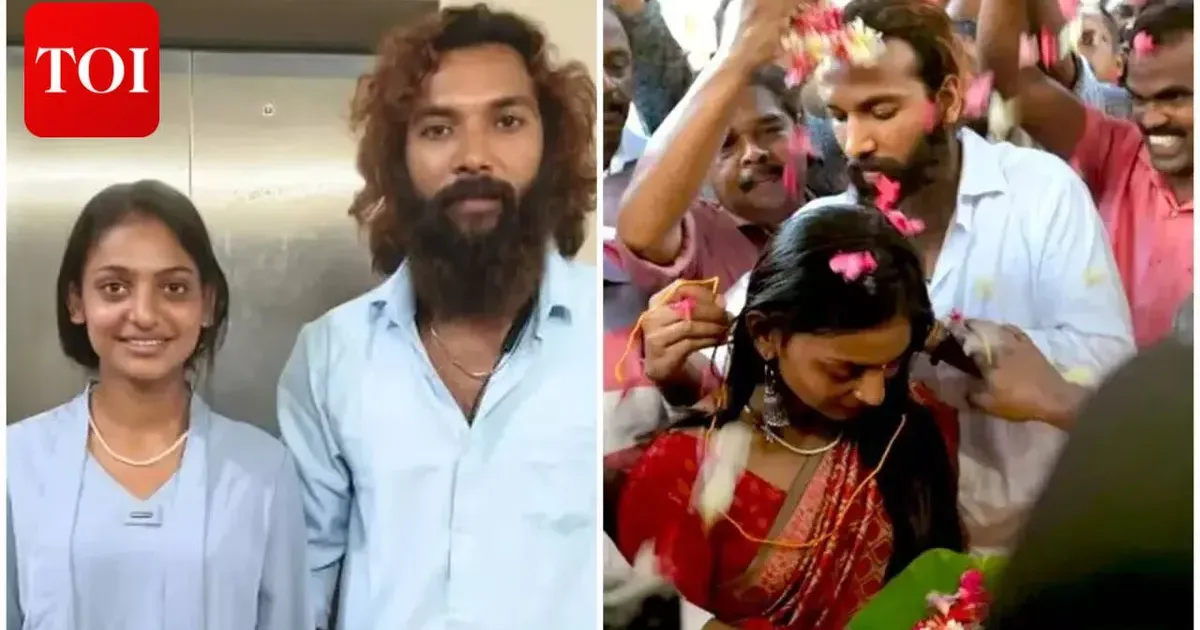
Monalisa Bhosle and Farman Khan's private Kerala ceremony shifted entertainment coverage toward a marriage story defined by restraint rather than spectacle. The ceremony drew attention on March 11, 2026.
Bhosle Marries Under Police Protection
Monalisa Bhosle stepped into the humid morning air of Kerala this week to claim a life she chose for herself. She moved with a quiet determination that stood in contrast to the chaotic energy of the 2025 Mahakumbh Mela, where she first entered the public consciousness. Her journey from the banks of the Ganges in Prayagraj to a quiet temple in southern India provides a window into the evolving dynamics of personal agency within conservative social structures. Local authorities in Kerala provided a security detail for the ceremony to ensure the safety of the couple. This protection became necessary when her decision to marry across religious lines met with fierce resistance from her kin. Her rise to prominence began during the massive spiritual gathering in 2025. A video captured her selling rudraksha beads and traditional garlands, her striking presence and articulate manner capturing the attention of millions. Such digital fame often proves fleeting, yet for Bhosle, it served as a catalyst for a series of life-altering decisions. The transition from a viral sensation to a woman managing a complex inter-faith marriage highlights the tension between traditional expectations and individual desires. Many saw her as a symbol of the modern pilgrim, but her private reality involved a burgeoning relationship with Farman Khan, a man who would eventually become her husband.
The couple's safety required state protection around a private vow, turning an intimate ceremony into a public test of personal freedom.
Khan and Bhosle chose the Nainar Temple for their nuptials. The choice of location was deliberate, offering a degree of distance from the immediate pressures of their home regions. Journalists gathered outside the venue noted a heavy police presence. Officers stood guard at the entrances, acting on a formal request for protection filed by the couple days earlier. These law enforcement officials confirmed that the bride and groom felt their safety was at risk due to the vociferous disapproval of the Bhosle family.
The family members reportedly viewed the union as a betrayal of their heritage, reflecting broader societal anxieties regarding inter-religious partnerships in the subcontinent. Love found a way through the friction. Detailed accounts of their courtship suggest a relationship built over several years, predating the sudden burst of internet fame.
Viral Fame Becomes Legal Leverage
Khan, who has remained largely out of the spotlight compared to his wife, stood beside her during the ceremony with a resolve that mirrored her own. Reporters from various news agencies, including those from NDTV and the Times of India, have noted the couple sought legal counsel before moving forward with their plans. They wanted to ensure that every aspect of their union complied with state regulations, effectively insulating themselves from potential legal challenges by disgruntled relatives. The wedding proceeded without incident, a victory for the couple in an environment often defined by rigid social boundaries. Prayagraj in 2025 was a sea of humanity where Monalisa Bhosle was just one of millions.
Her sudden visibility changed the trajectory of her life in ways she could not have predicted while stringing garlands by the river. Digital platforms turned her image into a commodity, but they also gave her a platform that perhaps empowered her to resist traditional domestic pressures. She parlayed her brief moment of celebrity into a sense of independence. Yet, the same spotlight that gave her a voice also made her personal choices a matter of public debate. Her marriage is not just a private affair; it is a talking point for those interested in the shifting cultural currents of modern India.
Sociologists observing the fallout of her wedding suggest that her story is emblematic of a broader trend. Young women in India are increasingly using the autonomy granted by economic or social visibility to make unconventional life choices. While Bloomberg's regional analysis of social trends points toward a slow liberalization, Reuters' local sources emphasize the persistent dangers faced by those who cross communal lines. Bhosle's move to Kerala, a state often noted for its relatively high levels of social tolerance and literacy, was a strategic maneuver. It allowed her to access a legal and social environment more conducive to her marriage than the more conservative northern heartlands.
The social equation remains complicated. Opposition to the marriage was not subtle. Bhosle's parents and extended family reportedly exerted significant pressure on her to end the relationship in the months leading up to the wedding.
Religious Freedom Meets Family Pressure
To assume this union is a simple victory for romantic love is to ignore the simmering tensions of a nation in flux. We are seeing a collision between the ephemeral world of digital fame and the iron-clad reality of centuries-old social hierarchies. Monalisa Bhosle is not just a bride; she is a casualty and a conqueror of the attention economy. Her ability to turn a viral video into the leverage needed to defy her family is a fascinating, if somewhat cynical, evolution of the modern social contract. If you are famous enough, the state will protect your right to love whoever you choose, but if you are anonymous, you are often left to the mercy of the mob.
That disparity is the uncomfortable truth behind the headlines. The Kerala police did their job, but they did so because the cameras were watching. One must ask what happens to the thousands of other couples who lack a Mahakumbh pedigree and a viral footprint. They are the ones who truly bear the brunt of social stagnation. Bhosle and Khan have survived the first act of their drama, yet their long-term security remains tied to their ability to stay relevant or disappear entirely.
There is no middle ground for those who break the rules in the digital age.