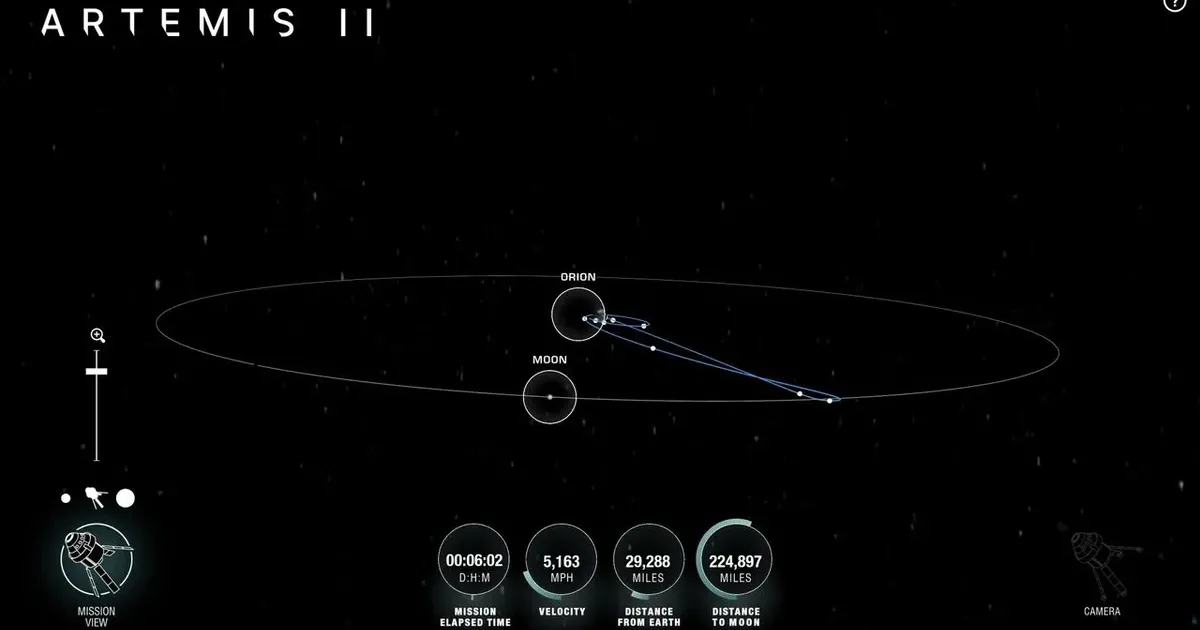
NASA's Artemis II crew is no longer preparing for a lunar trajectory burn. Reid Wiseman, Victor Glover, Christina Koch and Jeremy Hansen completed the first crewed Artemis mission in April, flew around the Moon aboard Orion and returned with the kind of data NASA needed more than another Apollo comparison.
The mission did not attempt a landing. Its job was to prove that Orion, the Space Launch System, ground teams, crew procedures and deep-space operations could support people beyond low Earth orbit for the first time in more than 50 years. The mission was less a spectacle than a systems audit with human lives inside it.
Orion Had to Earn Human Trust
Artemis I had already sent Orion around the Moon without a crew, but a crewed spacecraft is judged by a different standard. Life support, displays, manual controls, communications, water systems, suits, sleep schedules and emergency procedures all have to work under real human workload.
The Artemis II crew tested that reality from inside the capsule, which they named Integrity. Manual piloting demonstrations, suit checks, habitability routines and crew reports gave engineers evidence that telemetry alone cannot provide. Trust comes from people living and working inside a spacecraft while it flies, not from one flight alone while the mission keeps moving.
The Lunar Flyby Set a Human Distance Record
During the flyby, Orion reached about 252,756 miles from Earth, surpassing Apollo 13's human distance record. NASA also reported a closest lunar approach of roughly 4,067 miles above the Moon's surface. The distance figures matter because Artemis II went beyond tracing symbolic history. It expanded the verified envelope for a modern crewed lunar system.
The record's value is operational rather than a trophy by itself. The further Orion flew, the more NASA learned about navigation, communications blackout, thermal conditions, crew workload, return planning and deep-space decision-making.
The Crew Carried More Than Symbolism
Wiseman commanded the mission, Glover piloted Orion, Koch became the first woman to fly around the Moon and Hansen became the first non-American to do so. Those milestones gave the mission public meaning, but the crew's technical role was just as important.
The astronauts had to manage ordinary work in an extraordinary setting: monitoring displays, reporting symptoms, managing sleep, testing procedures and handling small operational issues before they became larger ones. The ordinary labor is what future lunar missions need most. Exploration fails when the routine cannot be trusted.
The July Reunion Shifted the Story Forward
Three months after the flight, the crew reunited with Orion at Kennedy Space Center. The reunion mattered because the capsule is now evidence, not just hardware. Post-flight inspection, crew debriefs and engineering reviews will shape what NASA changes before the next Artemis steps.
The reunion also underscored the emotional force of the mission. Public enthusiasm matters for a program that depends on budgets, partners and patience. But enthusiasm is not enough. NASA has to convert the flight into corrective work, design confidence and schedule discipline.
Artemis III Now Carries the Burden
The next phase is not a simple repeat. NASA has begun preparing hardware for Artemis III, a mission expected to test capabilities needed before a surface return, including docking and lander-related operations in Earth orbit. Artemis IV is now the clearer target for putting astronauts back on the lunar surface.
The sequencing may disappoint people expecting a direct sprint from flyby to landing. It is also the honest way to build a lunar program that survives. Artemis II proved people could fly Orion beyond the Moon and return. The harder program question is whether NASA and its partners can turn that proof into a reliable architecture instead of another brilliant one-off.