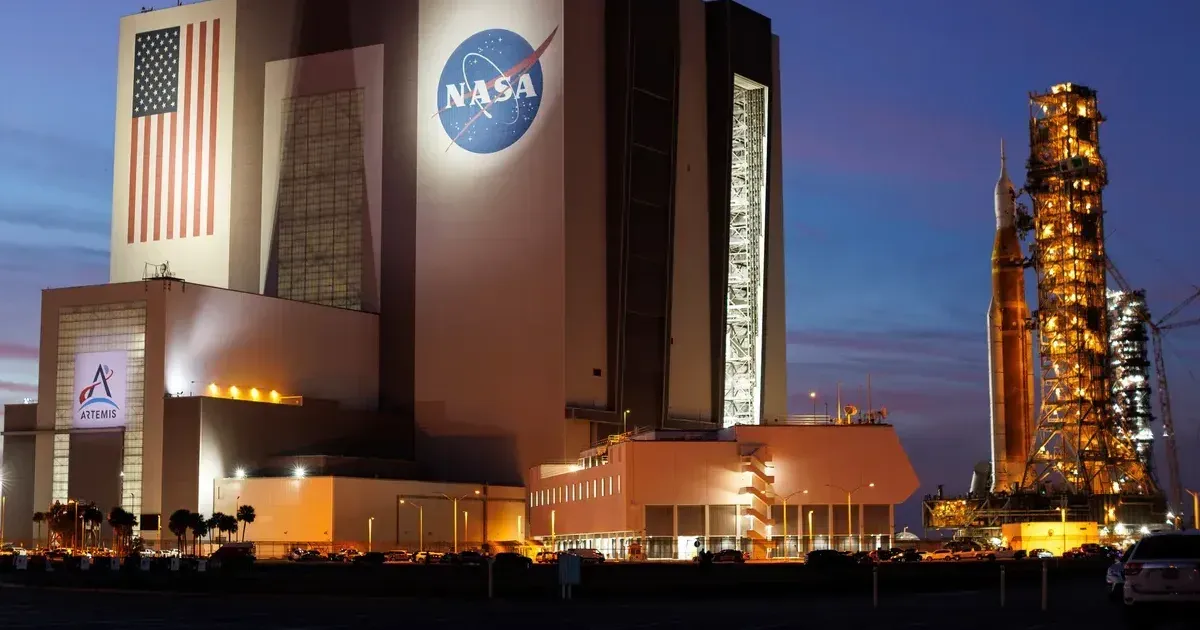
NASA has confirmed an April launch target for its crewed lunar test flight, putting the Artemis program back on a visible calendar after years of technical caution. The agency said in March 2026 that reviews supported moving toward an April attempt, with four astronauts set to fly around the Moon rather than land. By March 12, 2026, that distinction mattered. Artemis II is not the landing mission. It is the crewed stress test for the Space Launch System, Orion spacecraft, life-support systems, navigation and recovery operations. If it works, NASA gains confidence for the later mission that aims to put astronauts on the lunar surface.
A Crewed Test Before a Landing
The flight is designed to prove that Orion can carry people safely through deep space and return them through Earth's atmosphere at high speed. Uncrewed tests can validate hardware, but crewed missions reveal how systems perform when astronauts must live, communicate and respond inside the spacecraft. Artemis II will also test mission control procedures. NASA has to manage communications delays, trajectory corrections, medical monitoring and contingency planning far beyond low Earth orbit. Those operations are essential before any landing attempt.
Schedule Pressure Has Not Disappeared
Confirming a date does not remove risk. Launch windows can move because of hardware inspections, weather, range availability or late software concerns. NASA will face pressure to show momentum, but the agency has little incentive to force a crewed flight before engineers are satisfied. The broader Artemis schedule depends on several moving parts, including spacesuits, lunar lander development and future rocket readiness. A successful April mission would not solve every problem, but a delay or serious anomaly would ripple through the program.
The Moon Race Has Changed
The mission also carries geopolitical weight. China is advancing its own lunar ambitions, while commercial companies are becoming more central to American spaceflight. Artemis is therefore both a science program and a statement that the United States can still organize large, crewed exploration projects. For the astronauts, the public meaning is simpler. They would become the first crew in decades to travel beyond low Earth orbit, reopening a human pathway that closed after Apollo. That symbolism will matter even without a landing. The April window gives NASA a visible way to test whether Artemis is moving from promise to practice. The mission does not need spectacle to succeed. It needs a clean launch, a stable spacecraft, disciplined operations and a safe return. The crew profile adds another layer of scrutiny. NASA has to prepare astronauts not only for flight tasks but also for the psychological demands of a mission that will be watched as a national milestone. Training covers emergency procedures, spacecraft systems, medical response and the disciplined communication that becomes essential when public excitement is high.
The April target gives NASA a concrete test of whether Artemis is moving from promise to practice.
Recovery operations are just as important as launch. Orion must survive reentry, deploy parachutes and be retrieved safely after splashdown. A flawless outbound flight would still be incomplete without a clean return, because later lunar missions depend on confidence in the entire cycle.
Commercial partners will watch the mission closely. Artemis is no longer a purely government-built program, and future stages depend on private landers, suppliers and launch support. A successful crewed test can strengthen confidence across that network. A major delay can tighten schedules and raise costs for everyone connected to the program.
The scientific payoff is mostly downstream, but the operational payoff is immediate. NASA needs to know how the spacecraft behaves with people inside before it commits to more complex lunar operations. April gives the agency a target. The mission itself has to earn the next step.
The mission will also give NASA a chance to test public communication during deep-space operations. Apollo-era missions unfolded in a different media environment. Artemis will be followed through livestreams, short clips, classroom materials and constant online interpretation, making accuracy and pacing part of the mission experience.
International partners have a stake in the outcome as well. The Artemis program is tied to cooperation with agencies and companies that want a role in lunar infrastructure. A successful flight strengthens that coalition by showing that the core transportation system is moving.
There is room for caution without cynicism. Deep-space human flight is difficult, and schedule movement is not automatically failure. What matters is whether NASA can explain delays clearly, fix issues transparently and keep the program moving toward a credible landing sequence.
A clean Artemis II flight would also help NASA make the case for continued funding. Large exploration programs survive through technical progress and political patience. Visible success gives lawmakers, partners and the public a reason to stay with the program through the harder landing stages.
If the mission reaches that standard, Artemis will feel less like a delayed promise and more like an operating program again.
That progress is what the April target is meant to demonstrate.