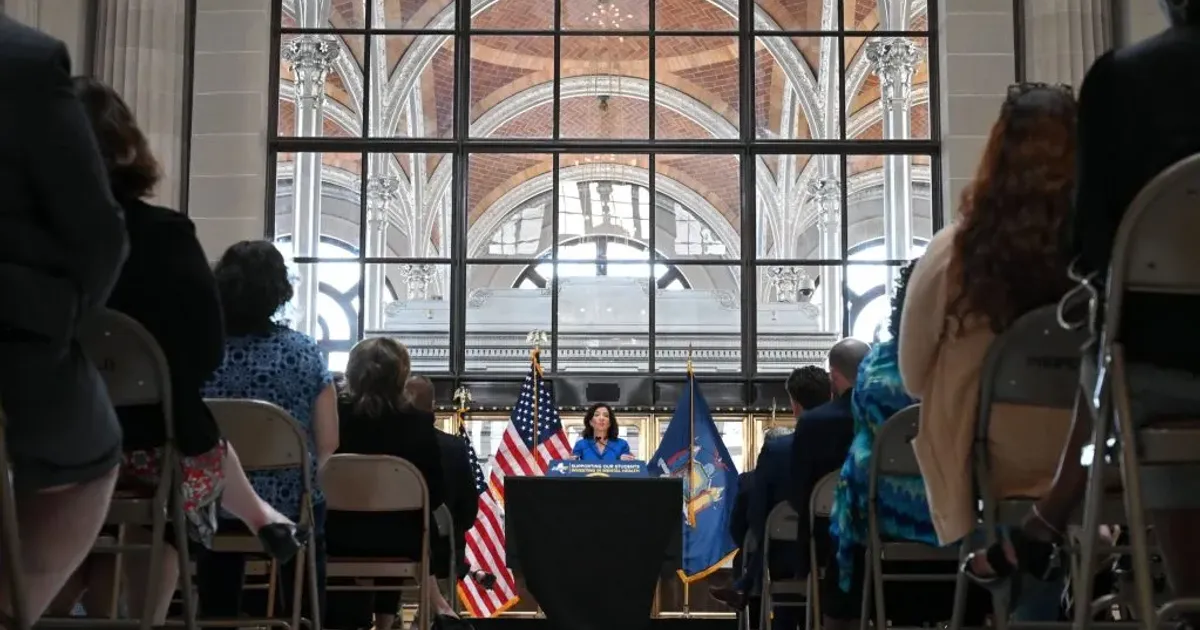
New York's reading push is facing the test every education reform eventually meets: whether money, training, curriculum and classroom practice point in the same direction. Gov. Kathy Hochul's Back to Basics plan promised a shift toward evidence-based reading instruction and required districts to certify alignment with state expectations by September 2025.
The policy language is direct. The implementation is less settled. Critics say teacher training and district curriculum choices still leave too much room for balanced literacy practices the state was supposed to move beyond.
The fight is instructional
The science of reading is not a slogan. In classroom terms, it points toward explicit, systematic instruction in phonemic awareness, phonics, vocabulary, fluency and comprehension. The practical center is that children need direct instruction in how sounds map to letters so they can decode unfamiliar words instead of guessing from context.
Balanced literacy remains contested because many versions blended some phonics with cueing strategies, leveled readers, picture prompts and encouragement to infer words from surrounding meaning. Supporters emphasize motivation, rich texts and comprehension. Critics argue that weak decoding instruction leaves struggling readers with habits that later become costly to unwind.
The training pipeline needs scrutiny
The March 2026 dispute centered on a $10 million grant and the role of New York State United Teachers in developing a free 30-hour course with the State Education Department. NYSUT says the course aligns with the science of reading. Literacy advocates have questioned whether parts of the training still reflect methods under criticism.
NYSUT has reach, trust with many educators and infrastructure for statewide delivery. Those assets make the union valuable for rollout. They also make independent review necessary. The larger the training pipeline, the larger the effect if the course leaves mixed signals in place.
Local curriculum control is the gap
The course fight is only one part of the problem. New York still gives local districts broad control over curriculum. Districts can certify alignment to the State Education Department, but certification is not the same as classroom change.
That gap showed up in later reporting. A May 2026 New York Focus analysis of mandatory school surveys found that more than 130 districts were still using balanced literacy curricula despite the state's new direction. If districts keep the same materials with a new label, the reform remains partly administrative.
Parents need visible evidence
The state can repair trust only by showing the chain from policy to classroom. That means public curriculum data, independent reviews of materials, clear teacher-training standards, early screening tools and coaching that helps teachers change daily practice rather than only complete a course.
It also means reporting outcomes without camouflage. If third-grade reading proficiency rises, the state should be able to connect progress to instructional changes. If it does not rise, officials should not hide behind implementation language while children keep receiving mixed methods.
The equity risk is immediate
The families with the least margin are the most exposed to a vague rollout. Affluent parents can buy tutoring, assessment and structured literacy support outside school. Low-income families often cannot. When the system sends mixed instructional signals, the damage does not fall evenly.
That is why curriculum alignment is not a bureaucratic detail. For a struggling reader, one more year of unclear decoding instruction can affect every other subject. Reading policy becomes real only when the materials, teacher moves and student practice change in the same classroom.
The reform has to show up
New York's literacy problem is an alignment problem. Public money, union training, district curriculum, classroom practice and student outcomes all have to point in the same direction. If they do not, the state can borrow the language of reading science while leaving parts of the old system intact.
The state has already identified the stakes: too many children are not reading proficiently by third grade, and early reading failure follows students into every other subject. New York does not need another promise that literacy is important. It needs proof that the adults running the system can make the promise visible in the materials teachers use and the skills children gain.