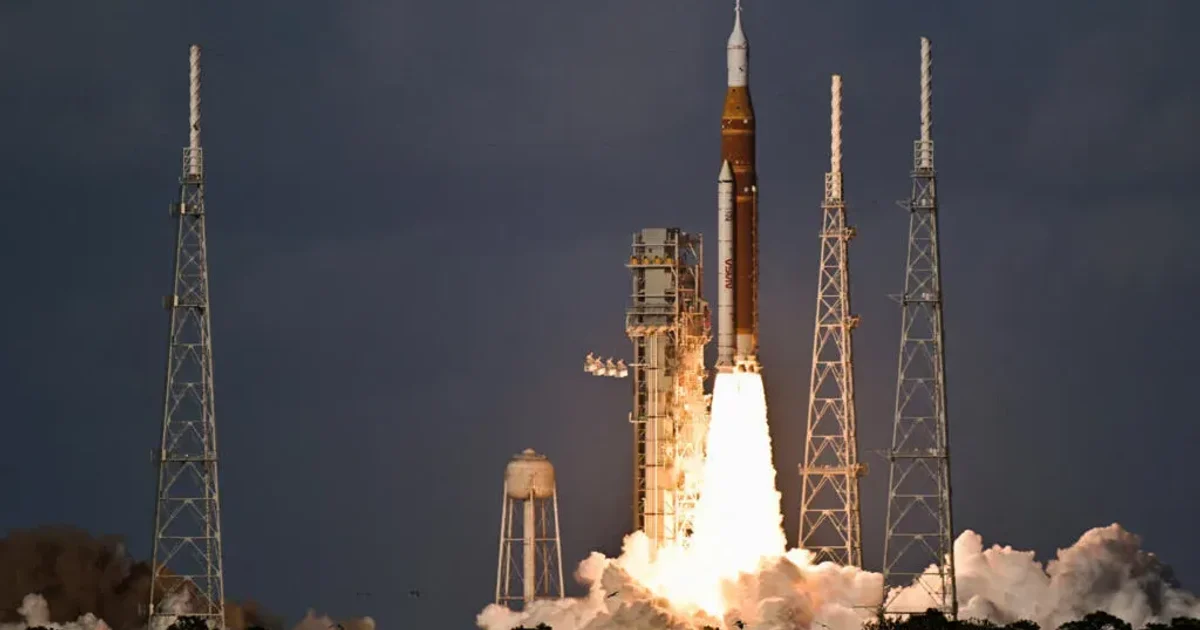
Artemis II's trans-lunar injection burn was the moment Orion Integrity stopped being an Earth-orbit checkout vehicle and became a deep-space crewed test. Launch put Reid Wiseman, Victor Glover, Christina Koch and Jeremy Hansen in space. TLI sent them toward the Moon.
Artemis II was not built as a landing mission. It was a proof flight for Orion, the European Service Module, crew procedures, mission control and recovery operations before later Artemis missions add docking, lander work and surface risk. The burn was therefore less a spectacle than a controlled decision to leave the safer part of the profile.
TLI separated checkout from commitment
Before trans-lunar injection, Orion remained close enough to Earth for the early mission to function as an extended systems checkout. The crew and controllers could test life support, communications, displays, navigation, procedures and spacecraft behavior while still operating inside a more recoverable phase.
After the burn, the mission had to prove itself in deep space. Navigation accuracy, power, thermal behavior, cabin habitability, communications, crew workload and return planning all became part of the evidence. A successful launch made Artemis II possible. TLI made it lunar.
The service module carried the decision
The European Service Module's main engine performed the outbound burn, with ESA describing the TLI firing as a 350-second maneuver that placed Orion and its crew on a free-return path around the Moon. The burn's precision mattered because later course corrections could then be smaller and fewer.
The burn was more than a propulsion event. It was a management judgment. NASA had to decide that Integrity's early performance justified leaving Earth orbit. The burn turned review data into action.
Free return kept the test disciplined
The free-return trajectory gave Artemis II lunar distance without the complexity of lunar orbit insertion or landing operations. The spacecraft could loop around the Moon and head back toward Earth without turning the first crewed Orion lunar flight into a mission overloaded with new objectives.
The conservative structure reflected sequencing, not a lack of ambition. NASA needed crewed data from deep space before stacking more risk on later flights. A simpler profile can still be a demanding test when it carries people beyond low Earth orbit for the first time in decades.
Completion changed how the burn reads
Before splashdown, the TLI burn was the departure headline. After safe return, it became the first link in a validation chain. Orion flew the lunar path, returned through Earth's atmosphere, was recovered in the Pacific and entered post-flight engineering review.
Safe return gave the burn its value. It helped NASA test reentry, recovery coordination, crew adaptation, cabin systems and spacecraft inspection with real lunar-flight data. Reaching the Moon's neighborhood was only part of the job; the mission also had to bring back information that can change the next design and procedure choices.
Later Artemis flights depend on this data
Artemis II did not need a landing to matter. Its job was to show that Orion and the ground system could support astronauts through a lunar flyby and return them with usable lessons. Minor anomalies, crew feedback and post-flight inspection belong in the same story as the burn because they decide how much confidence NASA can carry forward.
The TLI maneuver sent Integrity toward the Moon. The safe return made the maneuver consequential. Artemis II's most important cargo was not symbolism; it was engineering evidence brought back to Earth in a spacecraft NASA can inspect, question and improve.