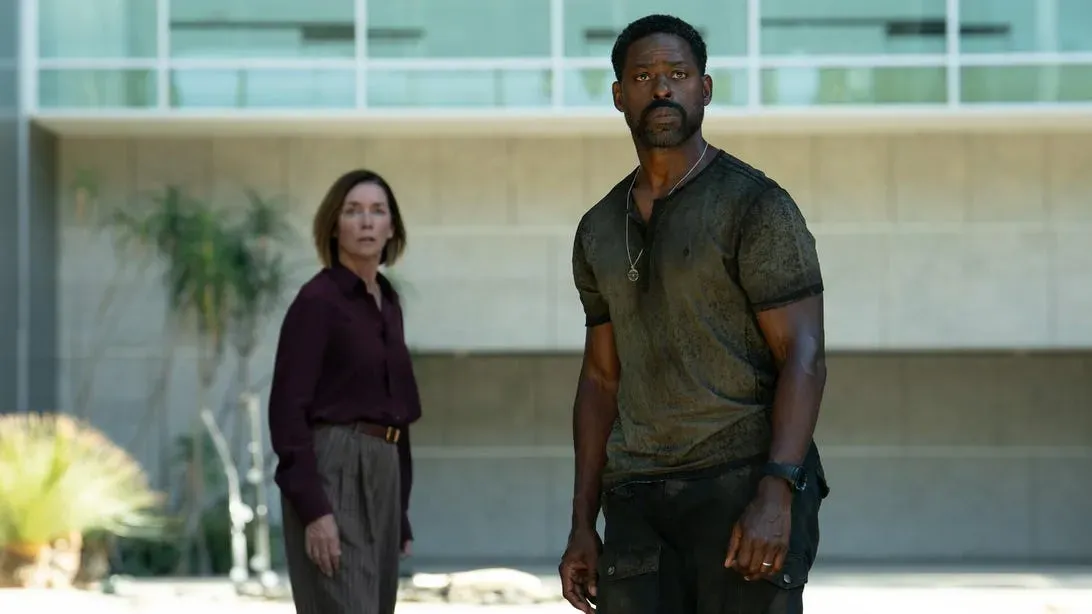
Paradise has reached the point where a bigger mythology is no longer enough. Hulu's Sterling K. Brown thriller has been renewed for a third season, and the creative conversation around the show now points toward an ending rather than an open-ended streaming run. The approaching endpoint changes the standard for the next chapter. Season 3 does not just need to surprise viewers. It needs to make the surprises feel earned.
The series began with the shape of a political murder mystery inside an artificial refuge. Over time, it moved deeper into post-apocalyptic science fiction, hidden systems, artificial intelligence, family separation and the question of who gets to control survival. The expansion has made the show more ambitious. It has also made the margin for sloppy writing much thinner.
Xavier Still Has To Carry The Weight
Sterling K. Brown's Xavier Collins is the reason the show can survive its larger turns. Xavier is not compelling only because he chases answers. He carries grief, suspicion, rage and a father's need to protect what remains of his family. Those emotions give the plot a human spine.
Mythology-heavy dramas can lose viewers when every episode becomes a file cabinet of clues. Paradise can ask the audience to follow bunkers, conspiracies, artificial systems and time-bending ideas if Xavier's choices remain clear. The show gets weaker if he becomes a tour guide through lore instead of a person being changed by what he learns.
The Sci-Fi Has To Change The Characters
Season 2 pushed Paradise further away from the simple version of its premise. The show is no longer only about the murder of a president or the secrets inside one protected community. It is about the design of survival itself: who built the systems, who was excluded, who benefits from the lie and what happens when technology turns memory, time or agency into a weapon.
Season 3 therefore has strong material, but only if the science fiction creates moral pressure. A reveal about an AI, a second facility or distorted reality cannot function as decoration. It has to alter the obligations between characters. If a new rule changes what Xavier owes his family, what the survivors owe each other or what the powerful owe the people they manipulated, it has value. If it only makes the maze bigger, it becomes noise.
A Planned Final Season Is An Advantage
Streaming mystery shows often fail because they mistake extension for depth. Paradise has a better chance because creator Dan Fogelman's plan has been described as a three-season arc. A three-season limit gives the writers a useful boundary. The final season can spend its energy on payoff instead of postponement.
Not every question needs a neat answer. The show can leave some emotional damage unresolved. What it cannot do is pretend that confusion is the same as sophistication. Viewers who invested in Xavier, Teri, the bunker society and the larger conspiracy need to feel that the series knew where it was going, even when it was hiding the route.
Hulu Has A Business Reason To Let It End
Paradise has value for Hulu because it gives the platform a recognizable adult genre drama led by a major actor. Its Emmy attention and global audience interest make continuation tempting. But the same success can damage a mystery if a platform asks for more seasons than the premise can support.
A clean three-season finish can travel better than a show that drifts into puzzle fatigue. Streaming viewers recommend mystery dramas in reverse: they ask whether the ending was worth the time. If Paradise lands its final act, the completed series becomes easier to sell to new audiences. If it stretches beyond its design, the early strengths become harder to defend.
The Risk Is Scale Without Discipline
Season 3 has earned the right to get stranger. It has not earned the right to get vague. The writers can widen the world, add new players and lean into heavier science fiction, but each move has to sharpen the central conflict. Xavier's search, the cost of survival and the ethics of controlled refuge should remain visible under every twist.
The best ending for Paradise would not be the loudest one. It would be the ending that proves the show's early political paranoia, family grief and later sci-fi machinery were part of one design. Brown can carry that final act, but performance alone cannot repair incoherent rules. The last season has to show that the maze was built for a reason.