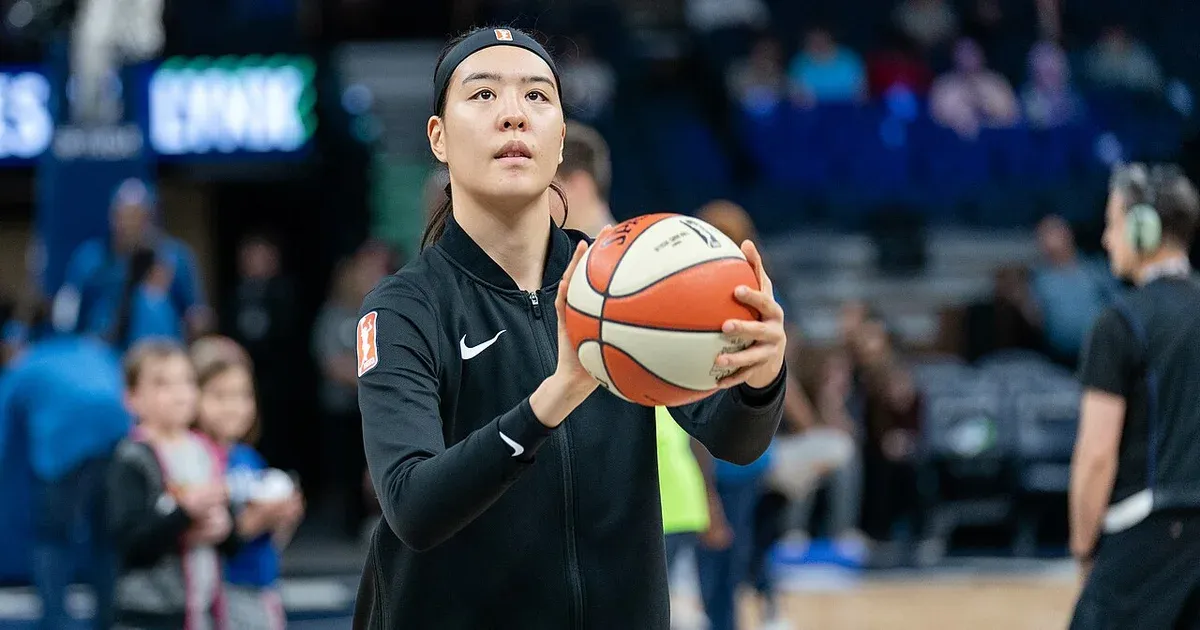
The award confirms a sustained dominance rather than a one-season spike. Park Ji-su now owns the league narrative. The fifth trophy changes the comparison set. On April 6, 2026, Park Ji-su was formally recognized as the most dominant force in South Korean women's basketball. Voters in Seoul overwhelmingly selected the Cheongju KB center as the regular-season Most Valuable Player for the 2025-2026 Women's Korean Basketball League (WKBL) season. Success for the athlete arrived through a combination of physical presence and refined post-play that anchored her team to the top of the league standings. Earning this individual honor places her in a rarefied tier of professional sports. She has now claimed five career MVP awards, moving closer to the all-time record currently held by legend Jung Sun-min. Critics often point to her height advantage, yet her statistical output across scoring, rebounding, and shot-blocking categories indicates a level of technical proficiency that goes beyond simple physical stature. During the awards ceremony, the atmosphere reflected a sense of inevitability regarding her selection.
Ballots cast by media representatives and league officials confirmed her status as the premier talent in the WKBL. Her performance throughout the winter months propelled Cheongju KB to a regular-season championship, ensuring home-court advantage for the upcoming playoff rounds. Despite facing double and triple teams in nearly every contest, she maintained efficiency ratings that led the league. Professional scouts from international leagues have noted her consistency over the last several seasons.
Winning five titles in a career is a feat few athletes achieve before reaching their thirties. Consistency characterizes her ten-year tenure in professional basketball since she entered the league as a highly touted teenager. Every season has seen a refinement of her mid-range jump shot, making her more than a traditional back-to-the-basket center. Analysts observed that her free-throw shooting improved to eighty-four percent this year, an impressive figure for a player of her size. This accuracy prevented opponents from using intentional fouls as a viable strategy to stop the clock.
“I want to rise to the top as the player with the most awards in history,” Park Ji-su stated during the ceremony.
Individual ambition drives her to surpass the benchmark of seven MVP trophies set by Jung Sun-min in previous decades. Achieving five such honors by the age of twenty-seven suggests she has ample time to rewrite the record books entirely. Beyond the domestic league, her aspirations include leading the national team to a higher ranking on the global stage. International competition has sharpened her skills, providing exposure to different officiating styles and physical play found in European and North American leagues. She mentioned that every award feels like the first one because the competition grows tougher each year.
Coaching Award Extends Seoul Night
Recognition for leadership extended beyond the playing roster during the Seoul event. Lee Sang-beom captured the Coach of the Year award, a selection that broke enduring league conventions. Historically, this honor goes to the coach of the first-place team, yet Lee secured the trophy despite leading his squad to a second-place finish. This decision reflected the consensus that he maximized a roster with much less depth than the championship-winning Cheongju KB side. Voters acknowledged his tactical ingenuity in keeping his team competitive throughout a grueling schedule.
Second-place teams rarely receive such high-level individual hardware in the WKBL. Lee used a rotation that relied heavily on developmental players and veteran leadership to stay within striking distance of the top spot. His defensive system focused on high-intensity trapping and forced turnovers, which compensated for a lack of interior size. Media members praised his ability to adjust lineups mid-game when his primary scorers faced foul trouble. The award highlights a shift in how coaching value is perceived by those who follow the league closely.
Coaches around the league noted that his team played with a specific identity that was difficult to replicate. By securing this award, Lee validated his status as one of the most respected tactical minds in Asian basketball. He accepted the trophy with a brief speech acknowledging his players' commitment to his demanding defensive philosophy. The final vote tally was closer than expected, indicating a divide among the electorate regarding the traditional link between team rank and coaching quality.
Park Ji-su’s Expanding Offensive Range
Examining the trajectory of Park Ji-su reveals a player who has matured into a multi-dimensional threat. Early in her career, she relied almost exclusively on put-backs and layups to generate offense. Recent shot charts indicate a diversification of her scoring zones, with fifteen percent of her attempts now coming from beyond fifteen feet. This evolution makes her nearly impossible to guard with a single defender. Opposition players have frequently commented on her improved footwork and ability to finish with either hand near the basket. Player efficiency ratings for the 2025-2026 season placed her at the top of the league by a wide margin. She led the WKBL in blocks per game for the fourth consecutive year, establishing a defensive reign that few have matched. Her rebound rate of twenty-two percent of available rebounds ensured that her team controlled the tempo of most games. These numbers were not hollow statistics accumulated in losing efforts. Every high-performance game coincided with essential victories against top-four opponents in the standings.
Future projections suggest that maintaining this level of play could result in a sixth MVP award as early as next year. Health stays the primary variable in her quest for the all-time record, as the physical nature of her position often leads to lower-body injuries. She has avoided major surgery throughout her professional career, a fact she attributes to a rigorous off-season conditioning program. Strength and conditioning coaches at Cheongju KB have designed a specific routine to manage the load on her joints during the forty-minute games. She averaged thirty-four minutes of playing time per contest during the regular season.
Fifth MVP Raises the Record Question
Park Ji-su’s fifth MVP turns an already dominant career into a direct pursuit of Jung Sun-min’s seven-award benchmark. At 27, she has the time to close the gap, but the case is stronger than longevity alone. Her improved shooting, league-leading interior defense and ability to absorb double teams made Cheongju KB’s regular-season title possible. Reducing that production to height ignores the skill development that has kept opponents from solving her.
The award also raises the standard for what comes next. A sixth trophy would tighten the historical comparison, while a championship run and stronger national-team results would give the individual honors broader weight. Health remains the only obvious variable. If Park sustains her current workload and efficiency, the league’s record book is no longer a distant target; it is the next contest.