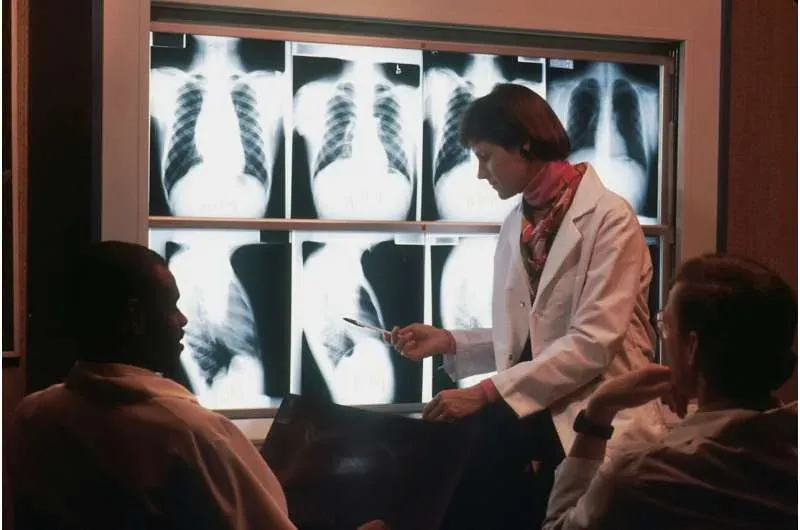
Predictions that artificial intelligence would make radiologists obsolete have not matched the work now taking shape inside hospitals. Interviews with UK imaging specialists describe something less dramatic and more consequential: software can flag findings, challenge a clinician's first impression and help organize work, but it can also produce results that professionals reject or must investigate.
That is not evidence that AI has failed. It is evidence that radiology cannot be reduced to recognizing a pattern in a single image. A model's output enters a chain that includes earlier scans, symptoms, clinical history, uncertainty, communication and decisions about what happens next. The real question is therefore not whether a machine or a doctor “wins.” It is how an institution assigns work, oversight and responsibility when both contribute to a decision.
Clinicians Report Useful Prompts and Visible Errors
The Medical Xpress report, republished from The Conversation, drew on interviews with professionals using imaging AI. A consultant neuroradiologist said a system's analysis did not always correlate with the clinician's own interpretation. A stroke physician described a case in which software appeared to mistake white bone on a CT image for white blood. Other clinicians said an AI alert could make them review an area again or could identify a very small abnormality they had initially missed.
Those accounts show why simple claims about superior accuracy are inadequate. The interviews do not determine whether the human or the system was correct in every disagreement, and they do not measure patient outcomes. They show that disagreement itself becomes clinical work. Someone must decide when to trust an alert, when to reject it and whether the case requires another image, another reader or a different test.
The report said the systems discussed in breast imaging and stroke care were being used to support consultant-level decisions rather than operate independently. It also noted that selective use of AI output is becoming a skill: uncritical acceptance creates one risk, while reflexive dismissal can discard a useful second signal.
Automation Happens Inside a Larger Workflow
Some imaging tasks are narrower than the profession surrounding them. Detection, measurement, segmentation, triage and draft reporting may be suitable for partial automation. In a service facing high demand and staff shortages, reducing repetitive work could be valuable. It may also give radiologists more time for complex cases, procedures and consultation.
But a task that becomes faster in isolation does not automatically make a department faster or patients safer. A 2026 paper in BJR|Artificial Intelligence argues that AI can reconfigure work by changing how tasks connect, who checks them and where responsibility sits. A tool may save time on an outline or measurement while creating new review, integration or exception-handling duties elsewhere.
This distinction prevents two opposite exaggerations. A useful alert does not prove that an entire profession is replaceable. A visible error does not prove that every model is useless. Performance depends on the specific tool, clinical purpose, patient population, workflow and threshold for action. Claims need to be tested at that level.
Radiologists Still Supply Context and Consequence
Radiologists do more than identify shapes. They compare current and prior studies, judge image quality, integrate clinical information, communicate uncertainty, recommend follow-up and discuss findings with other clinicians. Interventional radiologists also use imaging while performing procedures. These connected responsibilities are why automating one component does not erase the job.
The American College of Radiology's June 2026 perspective describes the near-term opportunity as using AI for detection, measurement, triage, drafting and information management while preserving human judgment, accountability and trusted communication. That is a professional position rather than proof that every deployment succeeds, but it identifies the standard hospitals should be measured against.
Patients should not be told that a product is reliable merely because it has entered a market or passed a regulatory pathway. Authorization addresses a defined product and intended use; it does not guarantee that the same tool will improve outcomes in every hospital. Local data quality, scanner settings, disease prevalence, integration and user behavior can all affect what happens after installation.
The Institution Cannot Automate Away Its Duty
A responsible deployment needs a clearly defined use, baseline performance, local validation where appropriate, monitoring for drift and a route for handling disagreement. Staff need to know whether an output is advisory, whether it changes worklist priority and who is expected to review it. Patients also need a system in which errors can be traced and corrected.
That governance work is not administrative decoration around the algorithm. It is part of the clinical intervention. If an alert changes which scan is read first, if a measurement enters a report or if a draft recommendation influences follow-up, the surrounding process can create or prevent harm.
The replacement debate obscures this harder responsibility. Hospitals can buy software, but they cannot transfer clinical accountability to a model, a vendor dashboard or a marketing accuracy figure. If an institution lets AI shape patient care, it must also name who watches the system, who can overrule it and who answers when it is wrong.