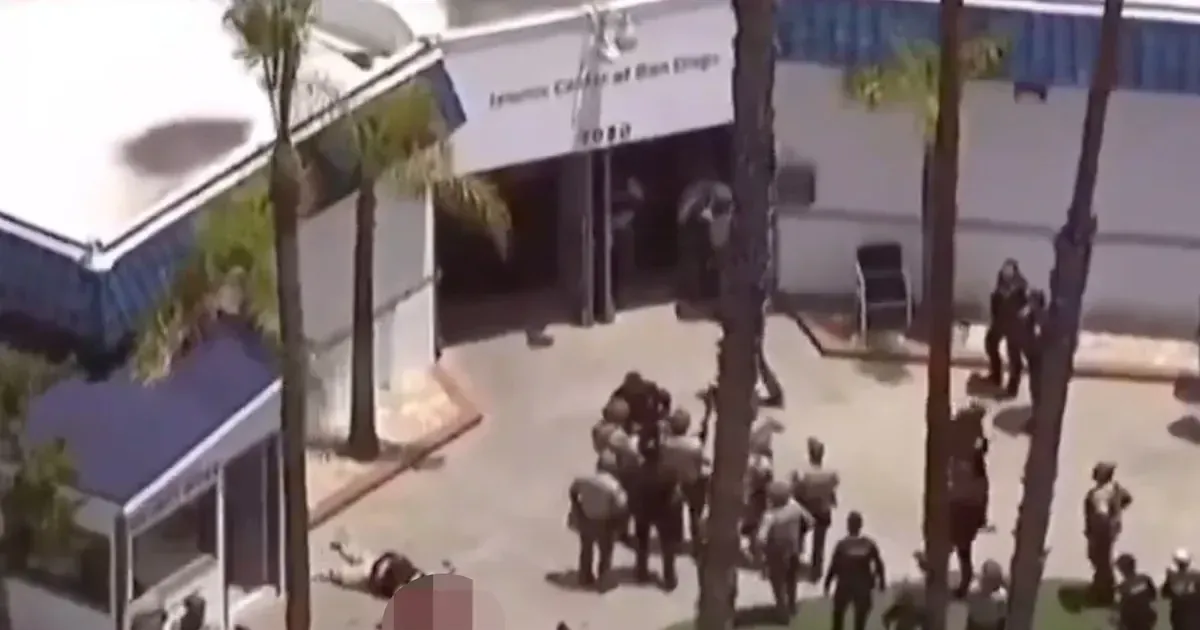
San Diego police units rushed to the Islamic Center of San Diego Monday morning to confront a reported active shooter at the facility. Patrol cars and tactical teams flooded the Clairemont Mesa neighborhood on May 18, 2026, after callers reported gunfire erupting at the county's largest mosque. Law enforcement officials established a wide perimeter as first responders worked to secure the area and assess the threat level within the religious complex.
Officers arrived at the scene shortly after the initial distress calls to find a chaotic situation involving hundreds of people. The Islamic Center is a major hub for the regional Muslim community, and the presence of numerous congregants required a swift and large-scale emergency response. Reports from the San Diego Police Department indicated that the situation was considered active for several hours while officers cleared multiple buildings on the center's campus.
Mosque leaders provided harrowing accounts of the initial moments of the violence. One senior official at the center stated that a security guard was killed during the confrontation. While police did not immediately confirm the fatality, the mosque leadership maintained that at least one staff member died while attempting to protect the facility. This assessment aligned with early reports from law enforcement regarding multiple serious injuries at the site.
The police told us to stay inside and away from the windows while they searched the main prayer hall for any remaining threats.
Casualty counts remain fluid as investigators process the scene. Emergency medical technicians transported several individuals to local trauma centers with what sources described as serious injuries. The exact number of victims and their current medical conditions has not been released by hospital officials. San Diego Mayor Todd Gloria posted a public message confirming his awareness of the active shooting and stated that city resources were fully committed to the response.
Secondary safety measures began immediately across the surrounding district. School officials moved to evacuate several nearby campuses as a precaution while the shooter's location remained unconfirmed. Parents were directed to designated reunification points located away from the primary tactical zone. The disruption extended to regional infrastructure as the California Highway Patrol closed several freeway lanes near the mosque to enable the movement of emergency vehicles. Commuters were urged to avoid the entire Clairemont Mesa corridor until further notice.
Witnesses described a heavy police presence that included armored vehicles and K-9 units. SWAT teams conducted room-by-room searches of the mosque and its administrative offices to ensure no other gunmen were present. The scale of the search reflected the large campus of the Islamic Center of San Diego, which frequently hosts large gatherings for prayer and community services. Aerial footage from local news outlets showed officers escorting groups of people out of the building with their hands raised.
Tactical teams eventually secured the perimeter, though the investigation into the shooter's identity and motive is still in its earliest stages.
Tactical Response and Neighborhood Lockdowns
Coordination between local and state agencies became a priority as the search for the suspect intensified. The San Diego Police Department worked alongside the FBI and the Bureau of Alcohol, Tobacco, Firearms and Explosives to process the complex scene. This multi-agency approach is standard for incidents involving religious institutions and potential mass casualty events. Officers cordoned off several blocks surrounding the mosque, effectively halting all civilian traffic in one of the city's busiest residential and commercial intersections. The shooting also raised broader questions about emergency planning at houses of worship and other public gathering sites.
Public safety officials used mass notification systems to warn residents of the ongoing danger. Those living in the immediate vicinity received alerts advising them to shelter in place and lock all doors and windows. The lockdown remained in effect for several hours as tactical units moved through the mosque's sprawling architecture. Officers found several individuals hiding in closets and storage rooms, many of whom were visibly shaken by the sound of gunfire within the sacred space.
Evidence technicians began the difficult task of mapping the ballistics data once the building was cleared. Preliminary findings suggest the shooter may have entered through a main access point before engaging the security personnel stationed at the entrance. Witness accounts suggest staff members at the entrance may have slowed the attack before police arrived. Investigators are expected to review closed-circuit television footage to reconstruct the timeline.
Regional Impact and Infrastructure Disruption
Traffic congestion rippled through the San Diego metropolitan area because of the proximity of the mosque to major transit arteries. Closures on the I-805 and I-15 freeways caused serious delays for thousands of midday travelers. Authorities maintained these closures to provide a clear path for ambulances and to prevent the shooter from potentially escaping into the heavy highway traffic. The gridlock persisted well into the afternoon as the police department maintained its command post near the facility.
Community centers and local churches offered their spaces to those displaced by the evacuations. Organizations across the city mobilized to provide food, water, and counseling services to the survivors and their families. The surge of local support occurred even as many residents expressed fear regarding the possibility of further violence. Police departments in neighboring jurisdictions increased patrols near other houses of worship as a preventive measure against potential copycat incidents.
Political leaders and civil rights organizations condemned the violence in the hours following the shooting. Statements from the Council on American-Islamic Relations emphasized the need for increased security at religious sites and called for a thorough federal investigation. These groups highlighted the mounting concerns over safety at mosques across the United States. The Islamic Center of San Diego has historically maintained its own private security, a practice that likely saved lives during the Monday morning assault.
The investigation into the shooter's background continues as forensic teams analyze digital footprints and personal records.
The Mosque Attack Tests Security Across an Entire Urban Network
Violence at religious institutions requires a fresh review of tactical planning in high-density metropolitan areas. Security protocols at the Islamic Center of San Diego, while resilient enough to include armed guards, were still breached by a determined assailant. The breach highlights the difficulty of protecting public spaces that must remain accessible to the community while also hardening against targeted attacks. Future safety planning may need to move beyond physical barriers toward integrated surveillance and faster coordination between private security and municipal police.
Law enforcement agencies face the immediate challenge of managing the psychological fallout within minority communities. The decision to close major freeways and evacuate schools highlights the immense logistical burden these incidents place on city infrastructure. Municipal budgets may see increased pressure to fund permanent security details for prominent religious sites, a move that raises complex questions about the separation of church and state in public safety funding. The San Diego incident shows how quickly an active shooter response can draw personnel, traffic control, school coordination, medical transport, and federal support into one dense urban scene.
Technological tools, such as automated gunshot detection and direct communication systems, may move higher on the priority list for large public venues. Private security firms will likely see a surge in demand for specialized training that focuses on the unique layouts of mosques, synagogues, and churches. The final analysis of this shooting will dictate how San Diego and other major cities allocate their tactical assets during future periods of heightened social tension.