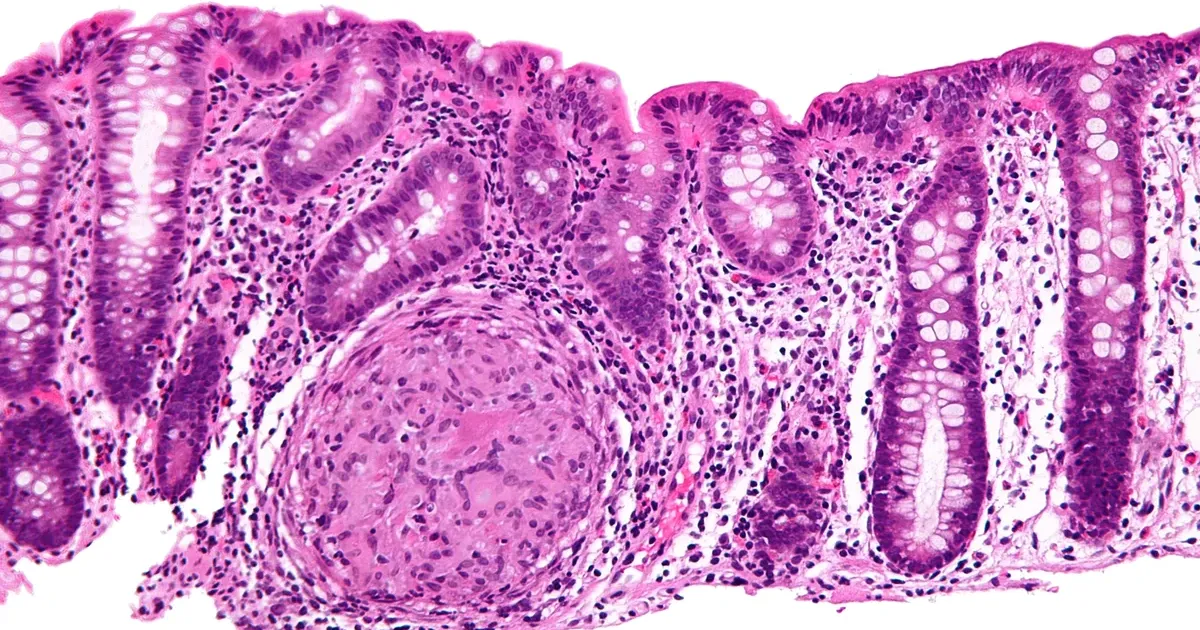
Researchers have described a rat model that develops mesocolic fat changes resembling "creeping fat," the abnormal tissue expansion that wraps around inflamed bowel in Crohn's disease. The work offers a way to study a poorly understood feature of the disease under controlled laboratory conditions, but it does not demonstrate a treatment or a new method for monitoring patients.
The study, published in Inflammatory Bowel Diseases, used 2,4,6-trinitrobenzenesulfonic acid, or TNBS, to induce colitis in Sprague-Dawley rats. Samples were collected five days after induction, making this a short animal experiment rather than a model of a patient's long-term clinical course.
Half of the Main Rat Group Developed the Fat Change
In the main experiment, five of 10 TNBS-treated rats developed visible hyperplasia of mesocolic adipose tissue near damaged and narrowed sections of colon. Three of five males and two of five females were affected, with no significant sex difference.
The finding was repeated in two other groups. An independent single-dose experiment found the change in 11 of 19 rats, while a repeated-dose protocol found it in six of 10. The researchers reported similar adipocyte hyperplasia, inflammatory-cell infiltration and fibre deposition across the single-dose and repeated-dose models.
Those frequencies matter because the model did not produce the feature in every animal. It created a reproducible subgroup with Crohn's-like changes, not a uniform copy of human disease.
Severe Colitis Was Linked to the Crohn's-Like Tissue
Animals underwent colonoscopy before TNBS exposure and again on days three and five. Rats with mesocolic hyperplasia had more severe colonoscopic lesions, greater weight loss and higher histopathology scores. In the main group, the fat change appeared in animals whose colonoscopy score reached at least seven on a nine-point scale.
Tissue analysis found deeper inflammatory infiltration and more fibrosis-related changes in affected animals. The hyperplastic mesocolon also showed increased expression of inflammatory cytokines and bacterial-recognition receptors, including IL-1 beta, IL-6, TLR2 and NOD2, when compared with sham controls or non-hyperplastic tissue for the measures reported.
Gram-positive cocci were detected in the subserosal layer of all five rats with hyperplasia and in two of the five without it. That association supports further study of bacterial translocation and fat remodelling, but the researchers explicitly said causality could not be established. They did not identify the bacteria by species.
The Model Resembles Creeping Fat but Is Not Human Crohn's
Creeping fat in people is hyperplastic mesenteric tissue around inflamed intestinal segments. It contains immune cells, inflammatory signals and fibrotic changes, yet its contribution to Crohn's progression remains disputed. Even surgical studies examining whether removing mesenteric tissue improves outcomes have produced conflicting results.
The rat tissue shared macroscopic, histological, immune and gene-expression features with human samples from people who had complicated Crohn's disease and underwent intestinal resection. That comparison strengthens the model's relevance, but resemblance is not equivalence.
The experiment has clear limits. Rat hyperplasia developed in the mesocolon, while human creeping fat commonly surrounds the ileocecal region. The main cohort was small, the endpoint was day five, and the tissue could not be identified before necropsy. No drug was tested, no patient outcome was measured and no blood or stool marker was validated.
A Useful Model Must Stay Inside Its Preclinical Boundary
The model gives researchers a practical platform for asking why severe intestinal inflammation and mesocolic fat remodelling appear together. It can also support future preclinical tests of therapeutic or surgical ideas. Those are worthwhile gains because the biological role of creeping fat is still unresolved.
Its value would be weakened by presenting it as an imminent clinical tool. The study did not show that doctors can measure creeping fat without imaging, adjust a patient's treatment from a new marker or prevent strictures by targeting fat. Each of those steps would require separate validation in animals and then in people.
The hard result is narrower and more useful: TNBS colitis produced a repeatable Crohn's-like fat response in a subset of rats, and the response tracked with severe tissue injury. That is a better experimental starting point. It is not a shortcut from a five-day animal model to a clinical revolution.