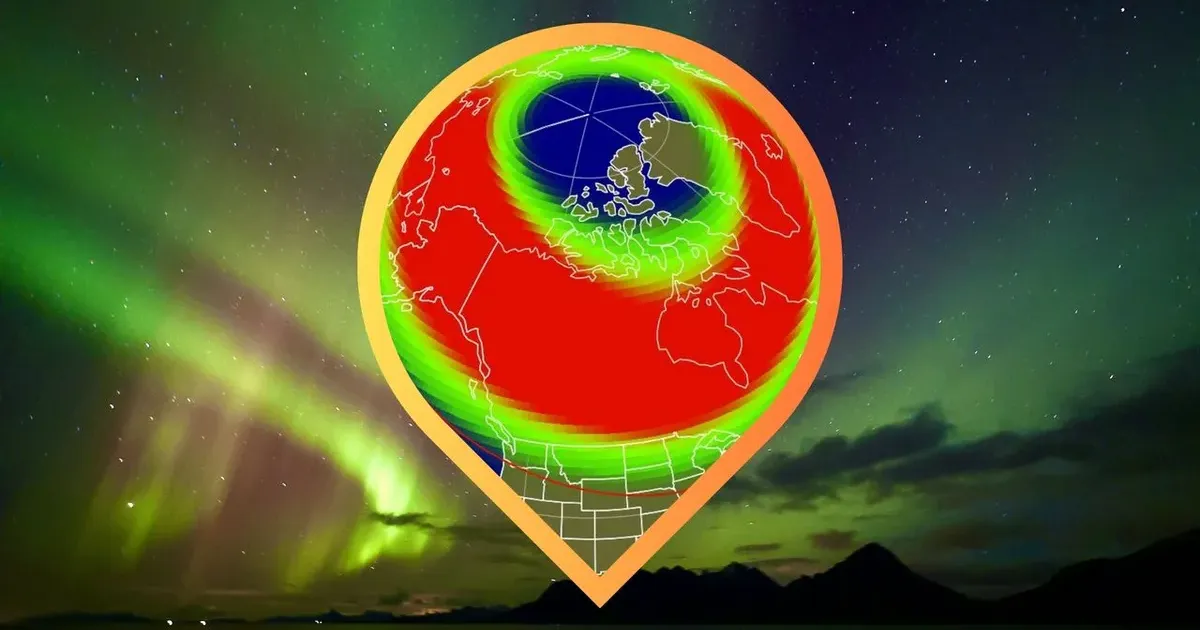
Skywatchers across 18 states prepared for a surge in the Northern Lights as solar winds collided with Earth's magnetic field. Researchers at the National Oceanic and Atmospheric Administration tracked multiple coronal mass ejections traveling toward the planet. These eruptions of plasma and magnetic field from the sun's corona carry the potential to disrupt satellite communications while creating vibrant atmospheric displays. Solar activity has increased sharply as the sun approaches the peak of its current 11-year cycle. Multiple plumes of solar material left the sun earlier this week and are expected to arrive in rapid succession. According to Space.com, the timing of these impacts coincides with a specific astronomical alignment that increases the likelihood of geomagnetic activity. Solar wind speeds often exceed one million miles per hour during these events. Particles interact with oxygen and nitrogen in the upper atmosphere to produce green and red hues. Meanwhile, the geometry of the solar system currently favors high-latitude observers. Magnetic fields between the sun and Earth are more likely to connect during the weeks surrounding the equinox. This connection allows solar particles to pour into the magnetosphere more efficiently than at other times of the year. Recent data indicates the interplanetary magnetic field has turned southward, a configuration that enables the opening of magnetic doors. The technical term for this seasonal increase in geomagnetic activity is the Russell-McPherron effect.
Solar Storms and Coronal Mass Ejections
Coronal mass ejections, or CMEs, function as the primary drivers of significant geomagnetic storms. Unlike the steady stream of the solar wind, these events are discrete bursts of billions of tons of magnetized plasma. When a CME strikes the magnetosphere, it compresses the sunward side and stretches the tail of the magnetic field. Energy then snaps back toward the poles, accelerating electrons into the ionosphere. These interactions occur primarily at altitudes between 60 and 200 miles above the surface.
In fact, the current forecast suggests at least three separate solar events will reach Earth before the weekend concludes. One fast-moving stream of solar wind originates from a coronal hole, a region where the sun's magnetic field lines are open to space. This wind acts as a persistent gale rather than a sudden gust. It can maintain aurora visibility for several consecutive nights if the orientation remains favorable. Monitoring stations in Alaska have already recorded heightened geomagnetic unrest.
Magnetic connectivity remains the most volatile variable in these forecasts. Even a powerful CME will fail to produce an aurora if its magnetic polarity matches Earth's own field. Like two magnets repelling each other, the solar wind can simply bounce off the magnetopause. To that end, forecasters look for a southward-directed Bz component in the solar wind data. This alignment promotes magnetic reconnection and the subsequent dumping of energy into the polar regions.
Russell-McPherron Effect and Equinox Alignment
Seasonal shifts play a hidden role in how the planet reacts to solar aggression. Equinox occurs twice a year when the sun sits directly above the equator, making day and night nearly equal in length. Alignment creates a specific tilt in Earth’s magnetic axis relative to the sun. Scientists have observed that auroras are twice as frequent during the weeks surrounding March 20 than during the solstices. The phenomenon has nothing to do with solar activity levels and everything to do with terrestrial orientation.
For instance, the Russell-McPherron effect explains why even weak solar winds can trigger bright displays in late March. The tilt of the planet allows for a more direct interaction between the solar and terrestrial magnetic fields. This effectively creates cracks in the magnetosphere. Smaller pulses of energy that would typically be deflected during the summer or winter now find easy passage. Such a mechanism ensures that the upcoming storm could outperform its raw data predictions.
But the equinox is only one piece of the puzzle. The sun is currently in a period of heightened activity known as solar maximum. Sunspots are more numerous, and flares occur with greater frequency during this phase. Each flare can launch a CME, and multiple CMEs can combine in space to form a cannibal storm. These merged events carry considerably more momentum and magnetic complexity. Observers should expect the most intense activity during the late evening hours.
Geomagnetic Impact Across Northern States
Forecasters expect the aurora to dip as far south as Illinois if the storm reaches a G3 level. The category of geomagnetic storm is considered strong and can require voltage corrections on some power grids. It also increases the drag on low-Earth orbit satellites, requiring frequent course corrections. While the visual beauty is the focus for many, the underlying physics presents a challenge for modern infrastructure. Radio blackouts can occur when the ionosphere becomes overly excited by solar protons.
Separately, the list of states with potential visibility includes Washington, Montana, and the Dakotas. Residents in New York and Maine may also see glows on the northern horizon if skies remain clear. Light pollution remains the greatest obstacle for viewers in more populated regions. Cloud cover across the Great Lakes could also obscure the view for millions of potential skywatchers. High-altitude clouds are particularly problematic because they block the very region where the light is generated. Aurora events turn space weather into a public experience. The spectacle is beautiful, but it also reminds utilities, airlines and satellite operators that solar activity is infrastructure risk.