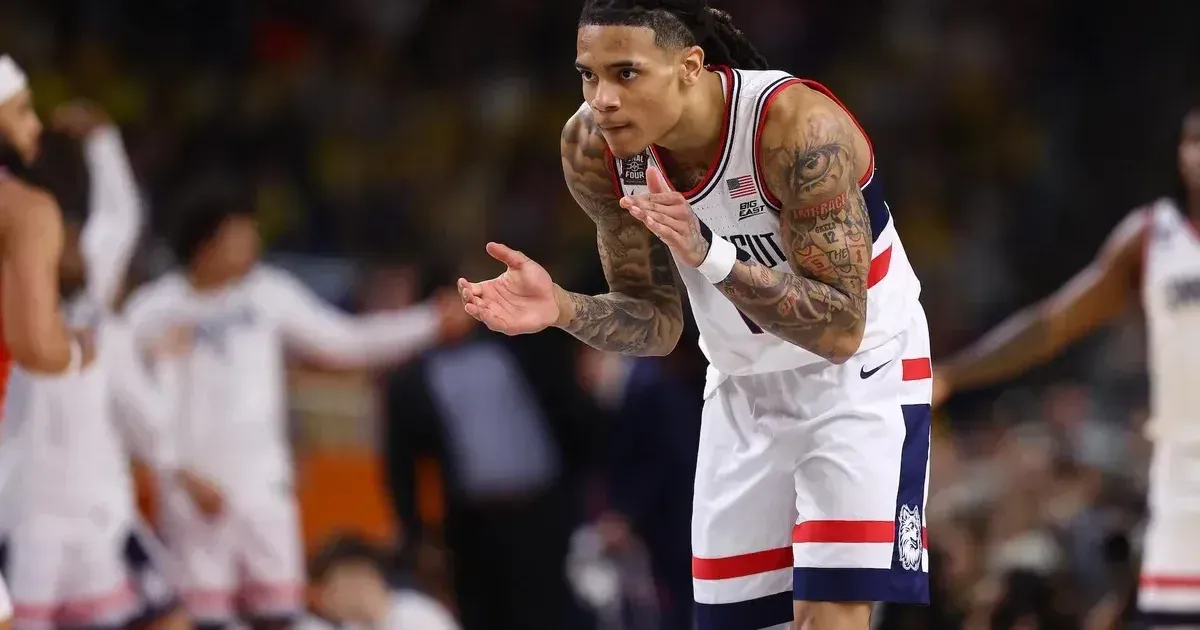
Solo Ball hobbled through the UConn team hotel as trainers evaluated whether he could play in the national championship game against Michigan. Medical staff placed the junior guard in a walking boot after a foot sprain, forcing Dan Hurley to prepare alternate guard rotations. The injury concern was active on April 5, 2026, as UConn balanced title-game preparation with the risk of pushing its third-leading scorer too soon.
Early reports from the training room indicate Ball collided with teammate Tarris Reed Jr. during the first half of the semifinal. He showed visible discomfort immediately after the contact but played through the physical limitation to contribute 13 points. Ball relies on explosive lateral movement and a quick release on his jump shot, both of which require a stable foundation in the lead foot. Medical experts suggest that sprains of this nature often peak in pain levels 24 to 48 hours after the initial trauma. The timing coincides exactly with the tip-off against a Michigan team known for a relentless, perimeter-focused defensive scheme.
Dan Hurley remains noncommittal about the starting lineup for Monday night. He mentioned on Sunday that the holiday schedule complicated the diagnostic process for the program.
“I don’t really know,” Hurley said when asked about the likelihood of Ball playing. “We’ll know more as it gets later in the day. He may not be able to get an MRI on his foot on Easter Sunday.”
Ball expressed a desire to compete despite the restrictive boot and the absence of practice time. He told reporters he is listening to the training staff while preparing mentally as if he will take his usual spot in the starting five. This mental preparation provides a necessary cushion for a player who has started all 38 games this season. Every start for UConn this year has featured Ball as a primary floor spacer and defensive anchor on the wing. Coaches must weigh the benefit of his presence against the risk of a limited athlete becoming a liability against Michigan’s speed.
Solo Ball Medical Status and Diagnosis
Team physicians have labeled the injury as a standard foot sprain, though they have not specified which ligaments are involved. If the damage sits in the midfoot, the recovery timeline typically extends far beyond a 48-hour window. Solo Ball described his current state as feeling alright, yet the physical constraints of the walking boot tell a more restrictive story. Players often mask pain during the adrenaline of a Final Four matchup, only to find the joint immobile the following morning. The lack of an MRI on Sunday leaves the coaching staff guessing about the structural integrity of the foot.
Reliability on the court depends on the ability to plant and cut without hesitation. Ball averages 12.9 points per game and is an essential release valve when defenses collapse on the interior. Losing that production forces UConn to redistribute 32 minutes of high-intensity play across a bench that has seen inconsistent usage. Statistical models suggest that the Huskies’ offensive efficiency drops by nearly 8 percent when Ball is off the floor for extended stretches.
The absence of practice reps on Sunday further complicates the tactical preparation for the Michigan defense. Ball has not missed a single game since joining the rotation, making this his first serious health hurdle in a Huskies uniform. UConn's path to the national championship game has been defined by a deep roster and elite coaching.
Dan Hurley Evaluates Championship Guard Rotation
Substitution patterns will change sharply if Ball is unable to provide his typical workload. Dan Hurley typically relies on a tight rotation during the knockout stages, but he may have to trust his reserve players in the highest-pressure environment in college basketball. Jayden Ross and Malachi Smith are the primary candidates to absorb the vacated minutes in the backcourt. Ross showed flashes of brilliance in earlier tournament rounds, scoring 11 points against UCLA and hitting two three-pointers in the win over Illinois. His length allows him to mimic Ball’s defensive footprint, even if he lacks the same veteran poise.
Malachi Smith offers a different profile as a ball-handler who can ease pressure from the primary point guard. While Smith is a reliable passer, he does not provide the same gravitational pull as a shooter that Ball possesses. Michigan defenders will likely sag off Smith to double-team the post, daring the reserve to hit contested shots. UConn coaches spent the afternoon adjusting their sets to account for these potential defensive shifts.
Ross appears ready for the challenge after his performance against Illinois.
Depth has been a talking point for this UConn roster throughout the winter. Now, the resilience of the bench personnel faces its ultimate test under the bright lights of the championship stage. Hurley has often praised the work ethic of his second unit, calling them the engine of the program during closed-door practices. Those verbal endorsements must now translate into scoreboard results against a Michigan squad that senses a weakness.
Statistical Impact of Solo Ball Absence
Shooting percentages for UConn from beyond the arc fluctuate when Ball is sidelined. He accounts for nearly 22 percent of the team's successful three-point attempts over the last ten games. His ability to hit shots in transition often prevents opponents from setting their half-court defense. Without that threat, the Michigan coaching staff can focus their efforts on neutralizing the UConn interior game. Records show that teams losing a double-digit scorer just before the title game suffer a meaningful dip in first-half offensive output.
Rebounding also takes a hit when the 6-foot-3 guard is missing from the perimeter. Ball averages 3.1 rebounds, often securing the long bounces that trigger the fast breaks. Replacement players must prioritize boxing out against a Michigan frontcourt that aggressively pursues second-chance opportunities. The margin for error in a national final is thin, and the loss of 13 points of production creates a vacuum that rarely gets filled by a single substitute.
Pressure on the remaining starters increases rapidly with Ball’s status in doubt.
Roster Risk for UConn
Ball's injury changes the championship equation because guard depth shapes both spacing and defensive pressure. UConn can adjust, but a title game leaves little time to test a new rotation.