A rare variant in the MGRN1 gene may help explain severe fetal heart defects in one family, according to the first report linking the gene to a human developmental disorder. The finding gives other genetics teams a candidate to examine when they encounter a similar combination of heart and body-positioning abnormalities. It does not establish MGRN1 as a routine prenatal screening gene.
The study concerned a healthy Estonian couple whose pregnancy history included two fetuses with complex congenital heart defects. One also had laterality abnormalities, in which organs or other structures develop in an atypical left-right arrangement. Standard chromosome testing, chromosomal microarray analysis and clinical exome sequencing had not identified a pathogenic or likely pathogenic variant in a gene already associated with the findings.
Research exome sequencing later identified the same rare MGRN1 change in both affected fetuses. Each had inherited one altered copy from each parent. That pattern, together with findings in mice, makes MGRN1 a plausible candidate. The authors nevertheless classified the specific variant as a variant of uncertain significance because evidence from a single family cannot confirm a new gene-disease relationship.
The Evidence Comes From One Family
The family had six recorded pregnancies. Two were medically terminated at 12 and 13 weeks after severe fetal abnormalities were detected. Another pregnancy ended in an early miscarriage without fetal tissue available for genetic analysis. Three children were born without the reported abnormalities.
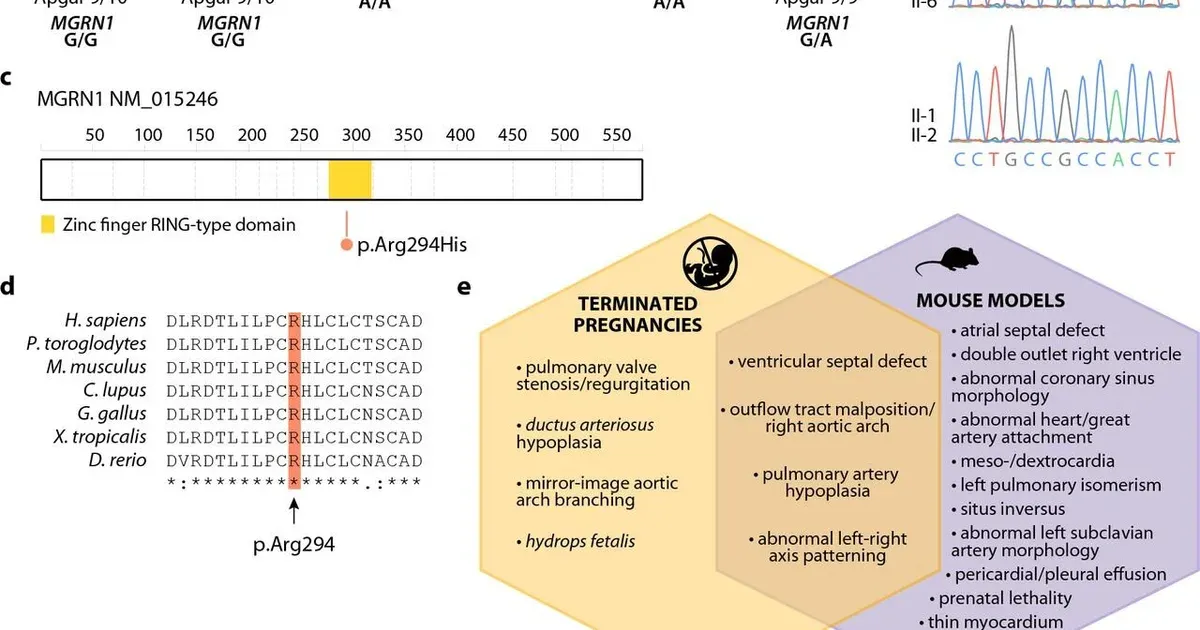
Researchers analyzed stored tissue from the two affected fetuses and blood samples from both parents. They found that both fetuses were homozygous for MGRN1 c.881G>A, which changes the protein at position 294 from arginine to histidine. The parents each carried one copy.
Testing of the three unaffected children strengthened the segregation pattern within the family. One carried a single altered copy, while two had two reference copies. None of the unaffected siblings carried two copies of the variant. The change is also extremely rare in large population databases, which contain no reported individuals with two copies.
That is meaningful family-level evidence, but the sample remains two affected fetuses from the same parents. The early miscarriage cannot be added as a third genetically confirmed case because no tissue was available. The study therefore cannot estimate how often MGRN1 variants cause disease, how broad the possible clinical presentation may be or whether this particular variant is sufficient on its own.
Genetic and Mouse Data Support a Candidate Link
MGRN1 encodes an E3 ubiquitin ligase, a protein involved in regulating other proteins inside cells. The altered amino acid lies in the protein's conserved RING domain, a region important to that activity. Multiple computational tools predicted that the substitution could be damaging, but a prediction is not a laboratory demonstration of impaired protein function.
Mouse studies provide a second line of supporting evidence. Animals with disrupted Mgrn1 can develop congenital heart and laterality defects that overlap with findings in the two fetuses. This biological consistency makes the human result more credible than a rare variant considered in isolation.
The overlap is not exact proof of causation. Mouse models can reveal a gene's developmental role, but they do not automatically establish the effect of a specific human variant. The researchers did not perform a protein-level functional assay to show how p.Arg294His changes MGRN1 activity. They also noted that exome sequencing may miss noncoding changes and that a more complex explanation involving other genes cannot be excluded.
The study's strongest contribution is therefore a coherent candidate-gene case: the inheritance pattern fits a recessive condition, the variant is rare, the affected residue is conserved and animal findings point in the same direction. Each piece supports the hypothesis. None removes the need for confirmation in unrelated families and functional experiments.
The Variant Remains of Uncertain Significance
Under the criteria used in the paper, the variant met evidence categories related to rarity, recessive inheritance and computational prediction. It still remained formally classified as a variant of uncertain significance, often abbreviated as VUS. The missing element is independent confirmation that biallelic MGRN1 variants cause a consistent human disorder.
This distinction matters in prenatal genetics. Professional variant-interpretation guidance states that a VUS should not be used in clinical decision-making. A candidate result may direct further investigation, family testing or case matching, but it is not equivalent to a confirmed molecular diagnosis.
The report does not show that MGRN1 should be added to standard prenatal screening panels. It does not establish a general recurrence-risk estimate, a fetal treatment or a delivery plan. It also cannot predict the outcome of a future pregnancy from this variant alone. Any interpretation would have to consider the full fetal phenotype, family history, inheritance data and the possibility that the classification may change as new evidence appears.
That caution does not make the finding unimportant. Rare-disease gene discovery often begins with a small number of carefully documented cases. Publishing the variant, phenotype and segregation pattern allows laboratories elsewhere to recognize a possible match instead of leaving similar cases disconnected.
Recognition Is the Next Step, Not Routine Screening
The immediate research priority is to find unrelated people or fetuses with two clinically relevant MGRN1 variants and overlapping heart or laterality findings. Multiple-family segregation data could show whether the pattern repeats. Functional studies could then test whether the variants alter protein activity and clarify the developmental pathway involved.
Data sharing is central to that process. A laboratory that encounters a similar case can now compare its findings with this family and contact the research community. A series of independent matches could strengthen the proposed association; cases that do not fit could also narrow or challenge it.
The publication expands the search space for unexplained congenital heart defects, but it does not close the case. Its value lies in making a carefully supported candidate visible, not in converting an uncertain variant into a clinical answer before the evidence is ready.
That boundary is especially important when genetic findings may influence decisions during pregnancy. The responsible conclusion is precise: MGRN1 now warrants serious investigation in matching cases, while p.Arg294His remains uncertain and cannot carry the weight of diagnosis or reproductive decision-making by itself. Case matching, functional validation and careful reclassification must come before routine clinical use.