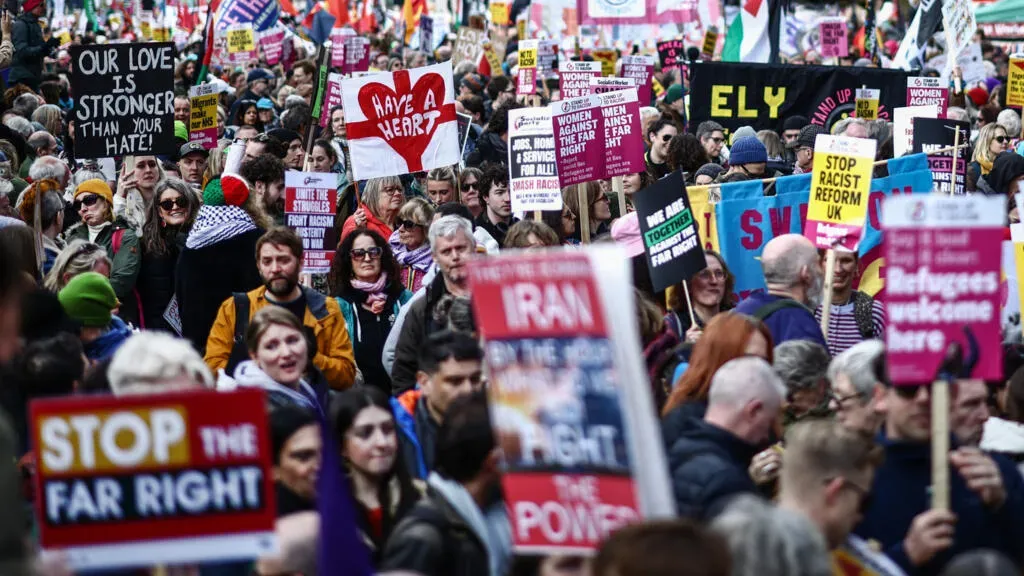
Tens of thousands marched through central London in a Together Alliance demonstration against the far right. The event took place on March 28, 2026, and organizers claimed a much larger turnout than police estimates. Both figures pointed to one fact: the march was one of the most visible anti-far-right mobilizations in Britain this year, with organizers framing turnout as proof of sustained street-level resistance.
The route carried demonstrators through symbolic parts of the capital, with banners focused on racism, nationalism and the politics of division. The march came ahead of local elections, giving the event a clear electoral context even though it was organized as a broader civil-society response. That dual identity shaped the tone. Speakers could frame the day as a defense of pluralism while campaigners treated it as a turnout signal before votes were cast. The march was therefore both a public statement and a test of whether anti-far-right groups could coordinate at scale.
Crowd Size Becomes Part of the Story
Organizers described the march as historic and said hundreds of thousands had joined. Police and media estimates were more cautious, placing the number in the tens of thousands. That gap is common at major demonstrations, but it also matters because turnout is used by both supporters and critics to judge momentum.
What is clear is that the Together Alliance brought together unions, anti-racism groups, artists and community organizations. The breadth of that coalition helped the march reach beyond a single party or campaign. It also gave the event a message that was moral and cultural as much as electoral.
That breadth can be a strength and a challenge. A wide coalition can attract people who would not join a party event, but it can also blur the practical demands that follow the march. The next stage requires translating shared opposition into local action that voters can recognize.
Local Elections Frame the Urgency
The timing was not accidental. Campaigners wanted the march to land before voters made choices in local contests where immigration, public services and national identity were already central themes. A large London demonstration cannot decide those elections by itself, but it can force party leaders to respond to the visibility of anti-far-right organizing. Police maintained a visible presence and kept counter-protesters separate from the main march. The event was largely peaceful, which allowed organizers to keep the focus on the size and message of the demonstration rather than on disorder.
The policing dimension also showed how predictable large demonstrations have become in London. Authorities plan for route closures, transport pressure and small counter-groups, while organizers work to keep the crowd moving. That choreography helps prevent confrontation but also adds cost and complexity to political expression.
Beyond the London March
Street protests can show that a coalition exists, but they do not automatically solve the economic frustrations that far-right movements often exploit. Housing pressure, insecure work and public-service strain still require policy answers. Without that substance, a march can become a symbol that reassures supporters without persuading skeptical voters elsewhere.
The Together Alliance now faces that harder task. If it can carry the energy into local campaigns, voter outreach and community work outside London, the march may become a major shift. If not, it will remain a striking image from the capital rather than a durable shift in national politics. The immediate lesson is measured but real: Britain still has a large, organized anti-far-right constituency, and it is willing to use public space to make that visible before election day.
Whether that visibility changes votes depends on what happens outside the capital. If the alliance can speak to towns facing economic strain without sounding dismissive of their grievances, the march may have reach. If it remains a London-centered spectacle, opponents will portray it as proof of the divide it claims to fight. The strongest next step would be practical rather than theatrical: local meetings, candidate pressure, voter registration and policy language that addresses housing, jobs and public safety without adopting far-right explanations. That is the difficult bridge for anti-far-right coalitions. They must oppose racism and nationalist scapegoating while still taking seriously the insecurity that makes such messages attractive to some voters. The march proved capacity. It did not yet prove persuasion. The coalition also has to handle the difference between mobilizing against a threat and governing around an alternative. Anti-far-right unity can fill a street, but local voters will still ask what replaces the politics being rejected. That question will follow the Together Alliance into every council contest and community meeting after the march. The next measure is whether that message can survive outside a large capital-city crowd and become practical local campaigning. That final step is where symbolic opposition becomes political work. That is the point where the demonstration becomes more than a single day in London. The post-march phase will decide that.