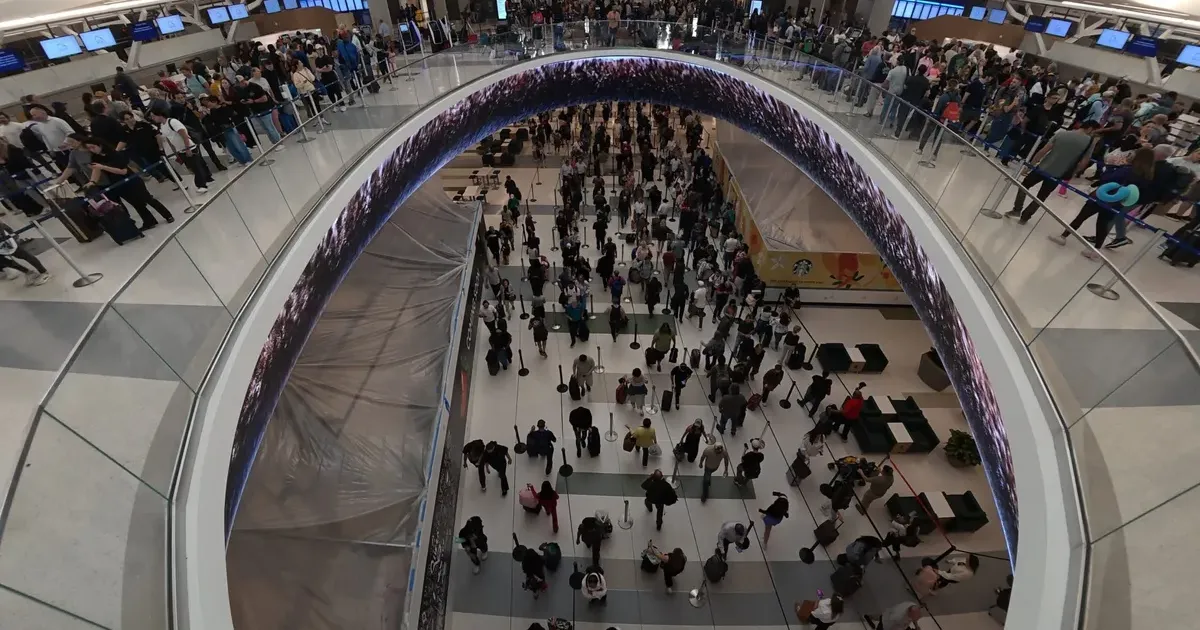
Airport security is becoming a labor story, a passenger-flow story and a privatization argument at the same time. The warning turns airport staffing into a broader argument about public control of travel infrastructure. On March 28, 2026, TSA union representative Jill DeJanovich warned that the federal funding standoff was putting screening officers under financial and operational pressure while travelers faced uneven checkpoint conditions. Her concern was not only about one shutdown cycle. It was that prolonged instability could make private airport screening look politically easier.
The warning came as airports tried to manage a second problem: passengers arriving too early and overwhelming terminal space before their flights were close to departure. John Glenn International Airport urged travelers to avoid crowding the building hours ahead of time, while reports from Baltimore-Washington International showed how long lines can still cause missed flights. The result is a confusing message for passengers: arrive prepared, but not so early that the airport stops functioning. DeJanovich’s argument is that uncertainty damages the federal workforce. TSA officers are expected to keep checkpoints moving even when pay is delayed or political negotiations remain unresolved. That strain can hurt morale, attendance and retention. Once staffing becomes less stable, privatization supporters can point to visible failures as evidence that the current model is broken.
The administrative detail matters because passengers usually see only the visible line. They do not see whether officers are taking extra shifts, whether absenteeism is rising, or whether supervisors are moving people between lanes to cover gaps. When those pressures are hidden, the public explanation can become too simple: the line is long, therefore the security model is failing. DeJanovich's warning was aimed at that simplification. It also explains why labor stability is part of airport capacity, not a separate workplace complaint. A checkpoint can have equipment, lanes and signage, yet still fail if the experienced people running it are treated as temporary shock absorbers.
Shutdown Pressure Revives TSA Privatization Debate
Airport privatization in this context does not mean replacing every federal security function overnight. The existing Screener Partnership Program allows airports to use private contractors under federal oversight. Labor unions fear that a funding crisis could shift the debate from a limited option to a broader political solution, especially if travelers blame checkpoint delays on TSA rather than on Congress.
The core risk is that emergency conditions become policy justification. A shutdown creates stress, stress creates delays, and delays create public frustration. If officials then argue that private screening would be more flexible, the labor side has to defend a system while its workforce is being asked to absorb the damage. That is why DeJanovich framed the issue as both operational and strategic. There is also a security argument. Federal screening was expanded after the September 11 attacks to create consistent national standards. Private contractors may still operate under federal rules, but unions argue that workforce churn and cost pressure can weaken institutional experience. In airport security, consistency is not a decorative value. It is part of the system’s reliability.
Passenger Timing Becomes an Operations Problem
The passenger side of the story is more practical but just as important. Travelers have been trained for years to arrive early, especially during holidays or staffing disruptions. Yet when too many people arrive far ahead of departure, pre-security areas fill with passengers whose flights are not next in line. That crowding can slow the very people who need to move fastest.
John Glenn International’s advice that 90 minutes may be enough for many travelers was an attempt to restore timing discipline. The airport was not telling passengers to be careless. It was telling them that terminal capacity depends on a steady flow rather than a flood. Security lines are not only about the number of officers; they are about the number of bodies arriving at the wrong time.
BWI shows the other side of the risk. If staffing strain and heavy volume combine, even passengers who arrive early can miss flights. That contradiction is why airport communication has to be specific. A generic “arrive early” message may create panic crowding, while a generic “90 minutes is enough” message may fail during sudden checkpoint stress. That distinction is especially important for smaller and mid-sized airports. A major hub may absorb disruption with more lanes, larger terminals and deeper management layers. A regional airport can feel the same disruption much faster because one staffing problem affects a larger share of the checkpoint. Privatization arguments often treat airports as interchangeable, but the operational reality is not that tidy.
What Travelers and Airports Can Learn
The immediate lesson for travelers is to follow airport-specific guidance rather than national habits alone. Some airports can process passengers quickly outside peak windows; others can jam suddenly when staffing, construction or weather disrupts the day. Checking live wait-time information matters more than relying on an old rule of thumb.
For airports, the lesson is that security operations and communications now have to work together. If management wants passengers to arrive closer to departure, it must provide credible updates, clear signage and enough staff to keep priority flights from being trapped behind people with later departures. The terminal is a timed system, not a waiting room with unlimited capacity.
For Washington, the lesson is sharper. A federal funding standoff does not stay inside politics. It arrives at checkpoints, paychecks and gate areas. If lawmakers allow TSA stress to become routine, they should not be surprised when privatization arguments gain traction. The better answer is to stabilize the workforce before passengers start treating every line as proof that the model itself has failed.