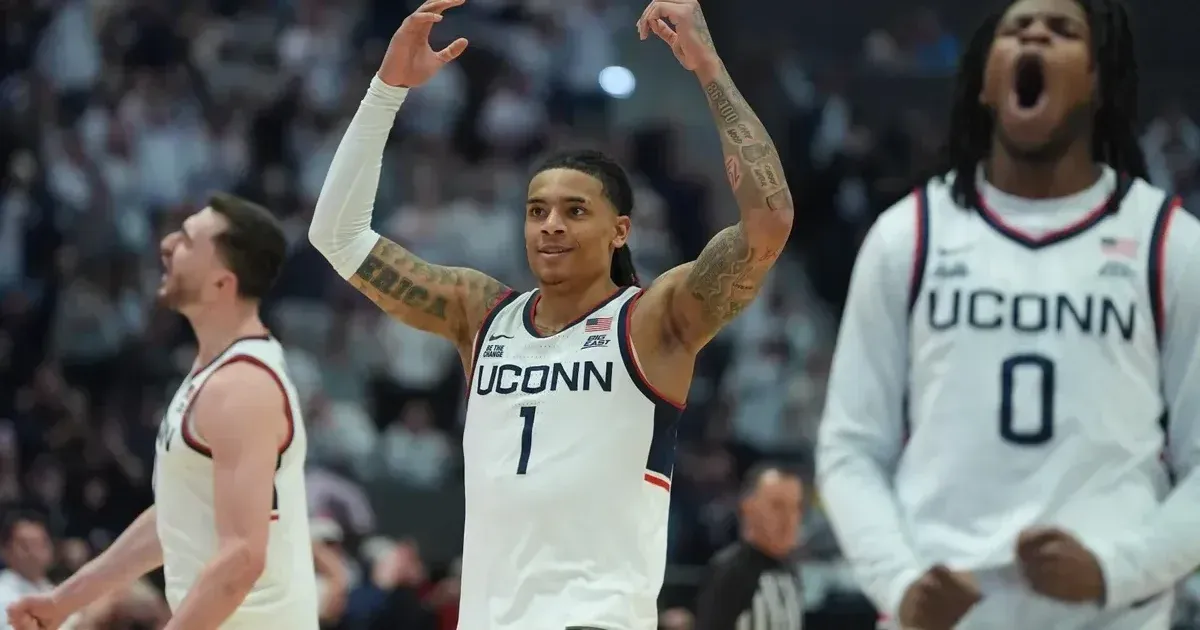
UConn and Tennessee enter Sweet 16 play with very different but equally narrow paths to survival. The matchup carries extra pressure because both programs entered the round with little margin for another lapse. The March 27, 2026 matchups place Connecticut against Michigan State and Tennessee against Iowa State, giving both programs little room for tactical error.
Michigan State, by contrast, relies on a veteran coaching staff and a rigorous defensive identity. Tom Izzo historically elevates his rosters during the second weekend of the tournament. Spartans players often find another gear when facing higher-seeded opponents. Connecticut players must account for Michigan State's ability to control the tempo of the game. Offensive droughts could prove fatal for any team in this environment. The matchup promises a physical battle in the paint from start to finish.
Connecticut Huskies Prepare for Michigan State Clash
Michigan State has leaned on defensive pressure and disciplined rebounding to reach this point. Connecticut will need to use its depth to keep the Spartans from controlling tempo and turning the game into a half-court grind. Depth is a luxury in November; in the Sweet 16, it becomes a survival tool.
Solo Ball has become a focal point for the Connecticut offense during high-pressure scenarios. His ability to create his own shot provides a safety valve when offensive sets break down. Michigan State will likely assign their best defender to shadow him for the duration of the contest. Huskies coaching staff may look to use him as a decoy to open up opportunities for their interior bigs. Connecticut big men have shown sizable improvement in their post-passing over the last month. Ball movement remains the key to unlocking the Spartans' shell defense.
Winning this matchup would propel UConn into the Elite Eight for another consecutive year. Programs with this level of consistency often benefit from a psychological advantage over their opponents. Michigan State players, however, are no strangers to the bright lights of the tournament. They have navigated difficult paths to reach this stage before. Basketball historians point to the 2000s as an era when these two programs first established their rivalry. Current rosters are well aware of the legacy they carry into the arena tonight. The UConn Huskies continue to draw significant attention as tournament favorites heading into the second weekend.
Tennessee Volunteers Face Iowa State Defensive Pressure
Meanwhile, the Midwest region features a collision between Tennessee and Iowa State that analysts describe as a defensive showcase. Rick Barnes has built a roster at Tennessee that thrives on physicality and transition scoring. Volunteers players often smother opponents with a full-court press that forces frequent turnovers. Iowa State will counter with a methodical approach and a defense that ranks at the very top of adjusted efficiency metrics. Scoring will be at a premium in this particular matchup. Both teams focus on defensive stops over offensive flair.
Tennessee has struggled in past years with scoring lulls during the second weekend. Barnes has emphasized offensive spacing and ball security to combat this historical trend. Volunteers guards must be disciplined when facing the Cyclones' aggressive trapping schemes. Iowa State specializes in creating chaos in the backcourt to spark their own offense. Turnovers often lead to easy buckets for a Cyclones team that sometimes struggles in half-court sets. Protecting the basketball is the primary directive for the Tennessee backcourt.
Iowa State can turn backcourt pressure into easy offense, which makes Tennessee's guard play the central issue. The Cyclones rotate quickly, take away first options and force opponents into rushed decisions. Tennessee will try to answer with size, rebounding and post touches that slow the game before Iowa State can dictate the rhythm.
Sweet 16 Pressure Point
Why do we continue to treat the NCAA Tournament as a meritocracy when the modern game is increasingly dictated by algorithmic simulations and betting models? The shift toward data-driven analysis has stripped some of the organic mystery from March. We are told by prediction models, television panels and betting markets exactly what to expect before the opening tip. This reliance on predictive modeling creates a sterilized version of competition where the human element is treated as an outlier.
If every expert at ESPN aligns on a single outcome, the eventual upset is not just a surprise but a failure of the system's logic. We have moved into an era where the software is often more respected than the players on the court. Rick Barnes and Tom Izzo are no longer just coaches; they are variables in a complex equation optimized for television ratings and sportsbook margins. The true beauty of the Sweet 16 should lie in its capacity to defy the data, yet we find ourselves deeper in the pocket of the predictors.
Real drama occurs when the SportsLine model is proven wrong, but the industry is built to ensure it is rarely surprised for long. We should stop looking at the screen and start watching the game for what it is: a chaotic, beautiful mess that no machine can truly master.