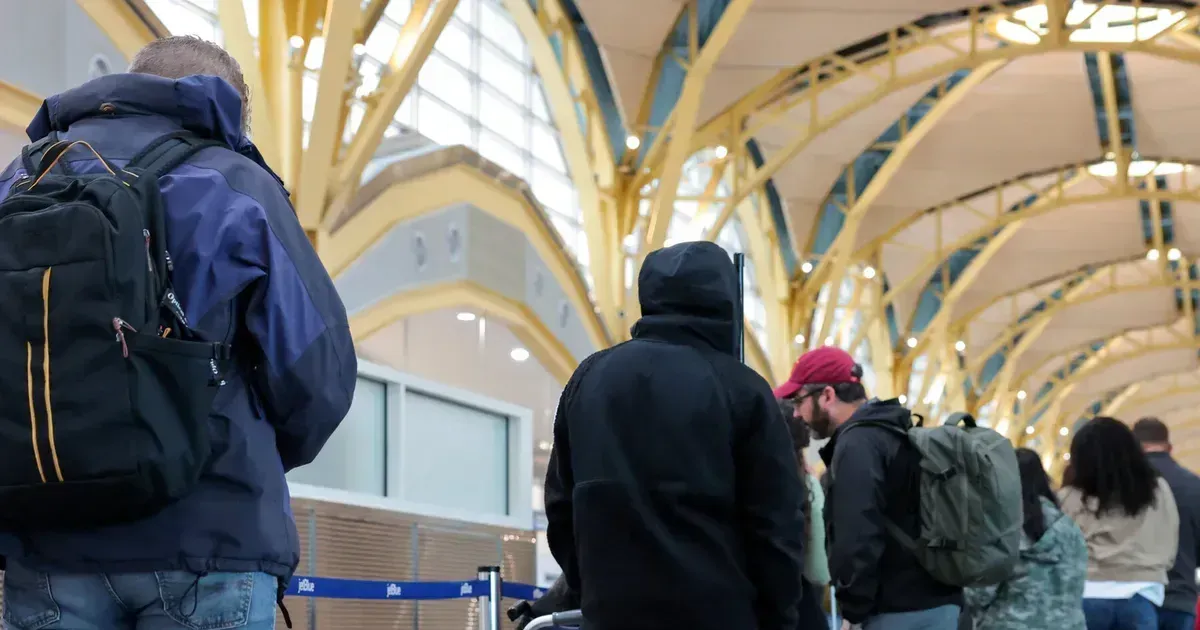
Security Work Without a Paycheck
TSA agents working without pay turns a budget dispute into a daily pressure point at airport checkpoints. The work does not pause because Congress misses a deadline. That creates the central tension: the public expects normal security, while the workers providing it are asked to carry rent, food and family costs without the income that normally supports the job. Federal pay delays are often discussed as abstractions, but airport security makes them visible. The immediate danger is not a formal collapse of screening.
It is attrition, sick calls, overtime stress and slower lines as workers decide how long they can keep showing up. That question has become part of the broader economic story. Essential labor can keep a system moving for a while, but it cannot make political dysfunction cost-free. Travelers see the line; agents live the missed paycheck.
How the Strain Reaches Airports
That gap can damage trust in government because it shows that critical operations depend on workers accepting uncertainty that elected officials do not personally face. The unpaid-work dynamic creates a strange public bargain. Travelers expect security to remain invisible when it works, yet the people maintaining that normalcy are absorbing the financial shock in private. Workforce strain can build before the system visibly breaks. A few missed shifts may be manageable; sustained uncertainty can change morale, retention and the willingness of experienced staff to keep carrying overtime.
Airports also have limited room for improvisation. Screening lanes, staffing levels and passenger surges are planned tightly, so worker absences can become long lines faster than officials admit. The broader economic lesson is that shutdowns do not only delay government paperwork. They shift costs onto households that have no role in the political standoff. That makes TSA agents a visible test case for essential labor.
If a government can require the work, it has to answer why the paycheck is treated as negotiable. The pressure also reaches families who have to make short-term financial choices while the public sees only the uniform at the checkpoint. Delayed pay can mean credit-card balances, postponed bills and stress that follows workers into high-attention jobs. Managers can try to rotate staff and keep lanes open, but they cannot remove the basic unfairness of requiring performance while withholding compensation. The longer the standoff lasts, the more the system depends on personal sacrifice instead of institutional resilience.
The shutdown turns airport security into a daily test of household endurance. TSA agents are expected to maintain the same screening standards while rent, childcare and transport costs keep arriving on schedule, creating pressure that eventually shows up in staffing levels and checkpoint speed.
Travelers often notice the problem only when lines lengthen, but the real strain begins earlier. Supervisors cover absences, officers delay bills, and a system built on routine compliance starts relying on personal sacrifice rather than stable public administration.
A Budget Fight With Human Costs
That is not a stable operating model for national transportation security. The public often notices the issue only when lines slow down, but the damage begins earlier. Workers who feel abandoned by the budget process may still do the job professionally, yet the institution loses goodwill that cannot be restored with back pay alone. A functioning security system depends on trust running in both directions. That is why the shutdown story reaches household economics as much as national politics.
A missed paycheck changes household behavior, reduces local spending and makes public-sector instability visible in family budgets long before official statistics catch up. Many are classified as essential, which means they can be required to work even when pay is delayed. If absences rise or morale collapses, screening lines can lengthen and airports may need to adjust operations. The TSA story is a reminder that infrastructure is not only concrete, scanners and schedules. It is people who show up on time and perform repetitive, high-stakes work under public scrutiny.
If Washington wants essential services to look stable, it has to treat essential workers as more than emergency shock absorbers. Otherwise the airport becomes the place where fiscal brinkmanship finally meets the public.