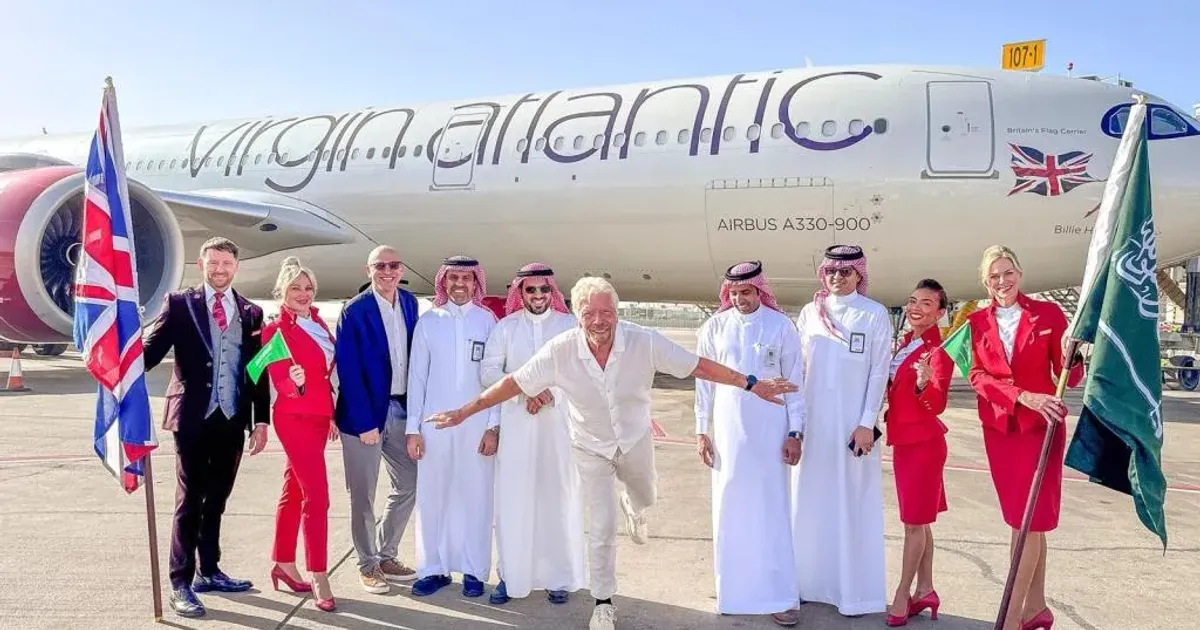
Virgin Atlantic terminated its direct service to Riyadh signaling a retreat from the Saudi market less than one year after launching the route with heavy promotion. Executive leadership finalized the decision to end the daily service from London Heathrow, opting to completely remove the destination from the network. While the airline previously suspended flights to Dubai during periods of regional volatility, the choice to permanently scrap the Riyadh connection points toward deeper commercial miscalculations. By March 31, 2026, Virgin's Riyadh retreat had exposed the route's weak economics. Internal data suggests that point-to-point demand failed to meet the aggressive yield targets required to sustain a long-haul operation in a crowded corridor.
Virgin Atlantic Operational Strategy Shift
Profitability concerns often dictate the survival of secondary routes in a network heavily focused on the North Atlantic. Virgin Atlantic relies on a hub-and-spoke model that funnels passengers from the Middle East through London and onto US cities like New York and Los Angeles. If the timing of the Riyadh arrivals does not align perfectly with the departures of the transatlantic fleet, the aircraft effectively fly half-empty. Market analysts suggest the Boeing 787-9 aircraft used for this route will be redeployed to more lucrative markets in the Caribbean or North America.
Operational efficiency became a secondary hurdle as the carrier faced ongoing engine maintenance schedules. Specifically, the Rolls-Royce Trent 1000 engines powering the 787 fleet have required frequent inspections and off-wing maintenance. High-cycle routes like London to Riyadh put meaningful strain on these powerplants. Rather than leasing expensive substitute aircraft, the board decided to shrink the network to match the available healthy fleet. Aircraft availability is a persistent bottleneck for carriers attempting rapid expansion into the Gulf region.
"We are constantly reviewing our network to ensure our aircraft are deployed where they can be most productive for our customers and our business," a Virgin Atlantic spokesperson said.
London Heathrow slot values play a serious role in these network adjustments. Every daily flight to Saudi Arabia consumes a slot that could potentially be used for an additional New York or Boston rotation. With transatlantic fares reaching record highs in early 2026, the opportunity cost of flying to Riyadh became too high to justify. Business travel between the UK and the Saudi capital has increased, yet much of that traffic remains loyal to the national carrier, Saudia, which offers higher frequency and established corporate contracts.
Middle East Aviation Market Competition
Competition in the Saudi aviation sector has intensified as the Kingdom invests billions into its domestic infrastructure. Saudia recently overhauled its fleet and improved its premium cabin offerings to retain high-net-worth travelers. These domestic improvements forced Virgin Atlantic to compete on price, which eroded the profit margins necessary to cover the high operating costs at Heathrow. Price wars in the premium segment rarely benefit a carrier with a smaller fleet and less frequent service.
Low-cost carriers and regional giants like Emirates and Qatar Airways also siphon off connecting traffic. Many travelers from Riyadh prefer to transit through Dubai or Doha due to the superior lounge facilities and more flexible connection times. Virgin Atlantic lacks a regional partner in the Middle East to provide feed for its London flights. This isolation left the Riyadh route vulnerable to any dip in direct tourism or business bookings. It also meant the airline could not easily rebook passengers during technical delays.
Economic headwinds in the UK have further suppressed outbound leisure travel to the region. High-interest rates and inflation reduced the disposable income of the British middle class, a demographic Virgin Atlantic typically targets for its Premium Economy cabin. Riyadh remains primarily a business destination, lacking the large leisure appeal of Dubai or the Maldives. Without a healthy mix of business and holiday travelers, the route struggled to maintain a consistent load factor above 75 percent.
Aircraft Maintenance and Fleet Constraints
Fleet constraints remain a primary driver of the sudden cancellation. Virgin Atlantic operates a relatively small fleet compared to British Airways or United Airlines. Every aircraft is an essential asset that must generate maximum revenue every day. If a single Boeing 787-9 is grounded for engine repairs, the airline must cancel flights across its entire network. Removing the Riyadh route provides a needed buffer in the flight schedule, allowing for better reliability on the core US routes.
Technical issues with the Trent 1000 engines have plagued the industry for years, and the supply-chain for spare parts is still recovering. Virgin Atlantic has had to ground several aircraft simultaneously in the past due to these durability issues. By cutting the Riyadh service, the operations team can consolidate maintenance resources and reduce the risk of rolling cancellations. Reliability is essential for maintaining the brand’s reputation among its loyal Upper Class passengers. The shift in focus prioritizes operational stability over geographical reach.
Future growth for the airline is now firmly centered on the Joint Venture with Delta Air Lines and Air France-KLM. The partnership allows Virgin Atlantic to offer seamless connections to hundreds of US cities, a benefit it cannot replicate in the Middle East. Strategic alignment with Delta ensures that the airline remains the primary choice for corporate travelers crossing the Atlantic. The Riyadh experiment, while bold, did not fit the long-term goal of becoming the most loved travel company. Route closures are the inevitable result of a sharpened focus on the bottom line. Virgin's retreat shows that prestige routes still have to survive aircraft constraints and competitive pressure. A new destination can fit a national growth story and still fail if yields trail better uses of scarce planes.
The Riyadh decision also protects Heathrow capacity for stronger partnerships. For travelers, the change means fewer direct choices; for Virgin, it is a bet that transatlantic flying offers a clearer return.