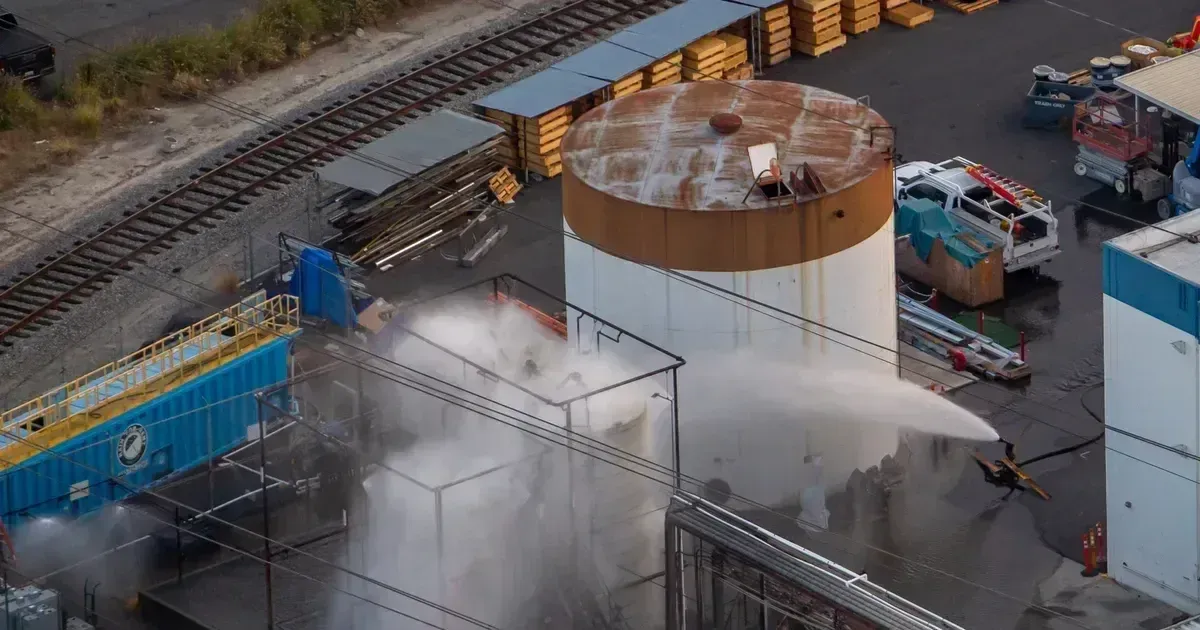
Emergency responders at the Nippon Paper Industries complex are navigating twisted steel and chemical runoff after a large tank imploded. The implosion has become both a rescue operation and an industrial-safety investigation. Families are waiting for news while engineers decide how close crews can safely work near the collapsed tank. The deadly structural failure occurred on May 28, 2026, leaving two workers dead and nine others officially listed as unrecovered. Rescuers spent the morning hours attempting to penetrate the collapsed outer shell of the industrial vessel while structural engineers monitored the stability of the remaining framework. State officials have not yet released the names of the deceased or those who remain missing under the debris.
First responders arrived at the Washington facility shortly after the pressure differential caused the enormous chemical storage unit to collapse inward. Unlike a typical explosion that throws debris outward, this implosion sucked the primary supports of the surrounding structure into the center of the tank. Early reports indicate that several other employees suffered injuries of varying severity during the initial collapse. Medical teams transported the wounded to regional trauma centers while the search for the unrecovered continued through the afternoon.
Video footage obtained from the site captures the scale of the devastation inside the facility. Steel beams appear twisted like wire, and the surrounding concrete flooring shows visible cracking from the force of the vacuum created during the failure. Morgan Chesky reported that authorities are currently treating the area as a high-risk zone due to the potential for further structural instability. Search teams are using specialized acoustic equipment and thermal imaging to locate any signs of life beneath the flattened metal panels.
Nine people remain unrecovered after a chemical tank imploded in Washington, officials say.
Washington state labor investigators are already on-site to begin a preliminary review of maintenance records. Preliminary data regarding the tank's contents remain shielded as the company works with environmental safety teams to contain potential leaks. Carter Evans noted that the incident may rank as one of the deadliest industrial tragedies in Washington state history if the missing nine workers are confirmed dead. Local law enforcement has cordoned off a half-mile radius around the plant to ensure public safety while heavy machinery arrives to assist in the clearing process.
Nippon Paper Industries has not provided a specific timeline for when the tank was last inspected for structural integrity. Industrial storage tanks of this scale typically undergo rigorous ultrasonic testing to detect thinning walls or corrosion that could lead to a pressure failure. Investigators, however, are looking into whether a ventilation error during a routine cleaning or filling process created the internal vacuum. Such a failure occurs when air cannot enter the tank as quickly as liquid is removed, causing the external atmospheric pressure to crush the vessel.
Local hospitals remain on high alert for additional casualties. The facility, a major employer in the region, has suspended all operations indefinitely while the recovery phase transitions into a full-scale forensic investigation. Families of the missing have gathered at a nearby community center to await updates from the Washington State Patrol and plant management. Officials have cautioned that the recovery process could take several days given the complexity of the wreckage and the danger posed by hazardous residues.
The Investigation into Structural Failure
Structural engineers are focusing on the internal pressure management systems that regulate the environment inside the chemical tank. A standard industrial vessel is designed to withstand substantial stress, but a sudden drop in internal temperature or a blocked breather valve can trigger a total collapse. Safety protocols generally require redundant sensors to alert operators of a pressure imbalance before it reaches a critical threshold. Investigators will examine the control room logs to determine if any alarms were ignored or if the sensors failed to detect the plummeting internal pressure.
Plant personnel who were on-site during the collapse are being interviewed to reconstruct the minutes leading up to the implosion. Eyewitness accounts suggest the sound of the collapse was more of a dull thud than a sharp blast, consistent with an implosive event. The Occupational Safety and Health Administration has joined the local task force to oversee the investigation into potential safety violations. They are specifically looking at whether the plant was operating at a higher capacity than the aging infrastructure could safely handle.
Safety Protocols and Regional Impact
Washington industrial sectors are bracing for increased scrutiny following this incident. Regional competitors may face immediate mandatory inspections of similar storage facilities to prevent a recurring failure. The economic impact on the local community is expected to be substantial, as the Nippon Paper Industries mill is a foundation of the regional supply chain. For now, the focus remains entirely on the nine individuals trapped within the debris field and the families waiting for a definitive resolution.
Industrial Safety Questions
Industrial safety often exists in the background of the global economy until a deadly failure exposes the fragility of aging infrastructure. This implosion highlights the specific dangers of pressure-vessel management, a field where errors are often silent until they become fatal. If investigators find that the collapse resulted from deferred maintenance or a failure to upgrade monitoring technology, it could trigger a national review of how chemical storage units are regulated and inspected. The potential loss of eleven lives marks a shift in the safety conversation for the Pacific Northwest industrial corridor.
For the families in Washington, the technical causes are secondary to the immediate human cost of a workspace that failed to protect its occupants. The outcome of the investigation will likely dictate the future of the Nippon Paper Industries presence in the state and set new precedents for industrial liability in the event of structural collapses.